
New Jersey Paycheck Calculator 2026
Estimate your New Jersey take-home pay from annual salary or hourly wages after federal income tax, Social Security, Medicare, New Jersey income tax, unemployment and workforce deductions, Temporary Disability Insurance, Family Leave Insurance, benefits, retirement, overtime, and other payroll deductions.
Quick Answer: How New Jersey Take-Home Pay Works
A New Jersey paycheck normally starts with gross wages and subtracts federal income-tax withholding, Social Security, Medicare, New Jersey Gross Income Tax withholding, employee unemployment and workforce contributions, Temporary Disability Insurance, Family Leave Insurance, retirement contributions, benefit premiums, extra withholding, and post-tax items.
New Jersey payroll is more layered than a simple federal-plus-state calculation. State taxable wages can differ from federal taxable wages, and NJ-W4 selections, Pennsylvania reciprocity, private disability coverage, governmental employer status, and multi-state work can change the final paycheck.
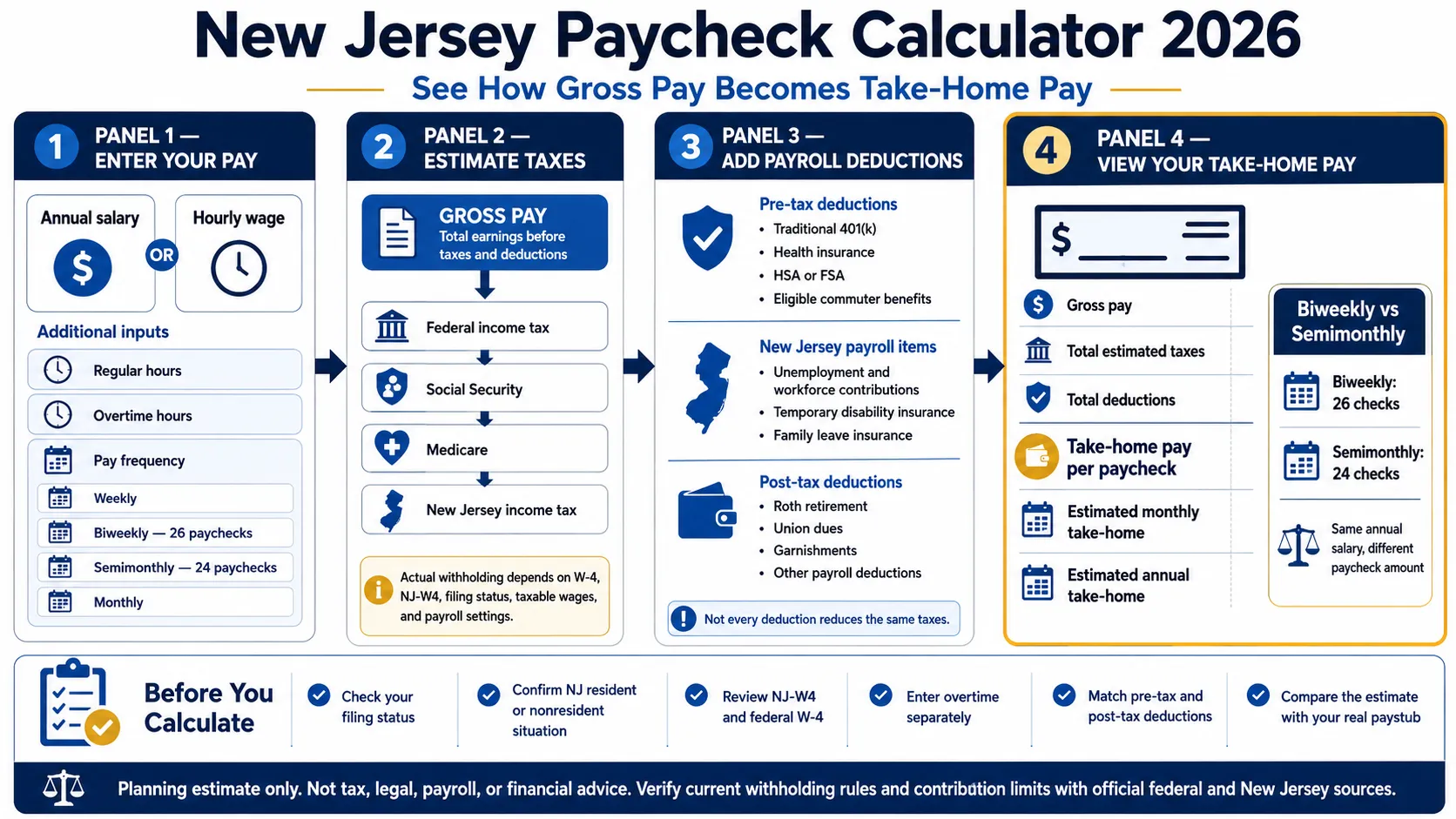
Choose the New Jersey Paycheck Calculation You Need
Start with the payroll question you are trying to solve. The same annual salary can produce a different check when pay frequency, overtime, NJ-W4 settings, work location, benefits, or state insurance wage caps change.
Evaluate a salary offer
Enter annual base salary, expected bonus, filing status, benefits, and housing costs.
Use: salary fields + job-offer toolCalculate hourly pay and overtime
Separate regular hours from overtime and use the multiplier that actually applies to the job.
Use: hourly mode + paid workweeksCheck a biweekly or semimonthly check
Select 26 checks for biweekly pay or 24 for semimonthly pay before comparing paystubs.
Use: pay-frequency fieldExplain a deduction mismatch
Separate federal pre-tax benefits, NJ-taxable benefits, FICA treatment, and post-tax deductions.
Use: deduction classification fieldsEstimate a bonus or commission check
Add annual supplemental wages for planning, then review the separate-payment rules below.
Use: bonus/commission fieldHandle PA reciprocity or multi-state work
Choose the correct withholding status and enter the percentage of wages connected with NJ work.
Use: NJ status + NJ-covered wage %New Jersey Paycheck Calculator With Taxes and Deductions
Enter the details that match your real job and payroll setup. Results update automatically and can also be refreshed with the calculate button.
New Jersey Tax Impact: Normal Withholding vs PA Reciprocity
This comparison isolates the estimated NJ-W4 income-tax withholding line. It helps a Pennsylvania resident review a valid NJ-165 setup, or helps any worker see how much of the current estimate comes from New Jersey income-tax withholding. NJ worker contributions can still apply to NJ-covered wages even when NJ income-tax withholding is zero.
| Scenario | Estimated paycheck | Estimated monthly take-home | Practical meaning |
|---|---|---|---|
| With NJ-W4 withholding estimate | $0 | $0 | Use for normal NJ withholding planning. |
| Without NJ income-tax withholding | $0 | $0 | Use only when an approved reciprocity or exemption setup supports it. |
| Estimated NJ withholding difference | $0 | $0 | This does not add Pennsylvania or another resident-state tax. |
Monthly New Jersey Budget From Your Paycheck
Take-home pay becomes more useful when it is compared with housing, commuting, debt, bills, and savings. This snapshot turns the annual net-pay estimate into a monthly affordability signal.
New Jersey Job Offer and Rent Affordability Calculator
Use this second tool before accepting an offer or signing a lease. It estimates monthly net pay and subtracts the recurring costs that can make a New Jersey salary feel different from its advertised gross amount.
How This New Jersey Paycheck Estimate Works
The calculator annualizes salary, hourly pay, overtime, and other wages. It then estimates federal income tax, FICA, New Jersey income tax, state worker contributions, deductions, and extra withholding before dividing the remaining amount by the selected pay schedule.
| Paycheck component | Calculation approach | Why a real paystub may differ |
|---|---|---|
| Federal income tax | Uses 2026 annual brackets, standard deductions, entered credits, and selected pre-tax amounts. | Employers use Publication 15-T, exact W-4 entries, pay-period methods, and rounding. |
| Social Security | 6.2% of estimated Social Security wages up to the 2026 annual wage base. | Year-to-date wages and benefit treatment determine when the wage base is reached. |
| Medicare | 1.45% of Medicare wages plus 0.9% employee withholding above $200,000. | Joint-return liability and employer withholding thresholds are not always identical. |
| New Jersey income tax | Uses the published 1.4% through 10.75% graduated rate schedules as a planning estimate. | NJ-W4 rate selection, allowances, state wage treatment, credits, and NJ-WT tables can change withholding. |
| NJ UI and workforce funds | Uses the selected worker UI rate plus 0.0425% workforce contribution on wages up to $44,800. | Governmental reimbursable employers use a different worker UI rate. |
| NJ TDI and FLI | Uses 0.19% TDI and 0.23% FLI on covered wages up to $171,100 when enabled. | Private plans, exemptions, prior employers, and year-to-date wage caps can change the current check. |
Before You Calculate: Information You Should Have Ready
| Information | Where to find it | Why it matters |
|---|---|---|
| Gross salary or hourly rate | Offer letter, employment agreement, paystub, or payroll portal | It is the starting point for gross-to-net calculation. |
| Pay frequency | Payroll calendar or recent paystub | Weekly, biweekly, semimonthly, and monthly schedules divide annual pay differently. |
| Federal Form W-4 | Employer HR or payroll portal | Filing status, credits, multiple jobs, and extra withholding affect federal tax. |
| Form NJ-W4 | Employer onboarding or payroll profile | The selected NJ withholding rate table can materially change state withholding. |
| NJ taxable wages | Paystub or W-2 Box 16 | New Jersey may treat benefits and retirement contributions differently from federal wages. |
| State contribution lines | Paystub lines such as UI/WF/SWF, DI/TDI, and FLI | These deductions use separate rates and annual wage bases. |
How NJ-W4 and NJ-165 Change Your Paycheck
New Jersey withholding does not use the federal Form W-4. Your employer needs the state form that matches your situation, and the details on that form can change the withholding estimate even when salary remains the same.
NJ-W4 Lines 2 and 3: filing status and Rate A–E
Single and married-filing-separately employees generally start with Rate A. Married-joint, head-of-household, and qualifying-surviving-spouse employees generally start with Rate B. The NJ-W4 wage chart can direct a household to Rate A, B, C, D, or E when a spouse works, the employee has more than one job, or combined wages and other income exceed the form’s threshold. Select that letter in the calculator instead of guessing from federal filing status.
NJ-W4 Lines 4 and 5: allowances and extra withholding
Line 4 allowances reduce estimated NJ withholding. Claiming too many can create an underpayment. Line 5 is an additional dollar amount withheld from each pay period; enter it in the calculator’s “Extra New Jersey withholding” field.
NJ-W4 Line 6: claiming EXEMPT
The current form states that a worker may claim EXEMPT when expected annual income is no more than $10,000 for single or married filing separately, or no more than $20,000 for married filing jointly, head of household, or qualifying surviving spouse. The certificate is valid for one year and must be submitted again for the next year. Do not select the calculator’s exemption option solely because a prior paycheck had no NJ tax.
NJ-165: Pennsylvania reciprocity
A qualifying Pennsylvania resident can give Form NJ-165 to the employer to claim exemption from New Jersey income-tax withholding and authorize Pennsylvania withholding. The employer keeps the form; it is not sent to the NJ Division of Taxation. The employee must notify the employer within 10 days after moving out of Pennsylvania. The reciprocal agreement does not eliminate Pennsylvania local wage taxes.
How Form NJ-WT Handles Multi-State Work and Supplemental Pay
Form NJ-WT is the employer withholding guide. Its rules explain several common differences between a simple annual estimate and the amount on an actual paycheck.
NJ resident working outside New Jersey
NJ-WT provides a limited rule under which an employer may stop NJ withholding when the employee works entirely outside New Jersey, is subject to withholding in the work state, and that state’s withholding equals or exceeds the New Jersey amount. A New Jersey resident can still have a New Jersey filing obligation, so this is not the same as becoming tax-free in New Jersey.
Nonresident working both inside and outside New Jersey
NJ-source compensation can be allocated using workdays when services are performed in multiple states. For a planning estimate, use the calculator’s NJ-covered wage percentage based on this relationship:
New Jersey workdays ÷ total workdays for the year × 100Travel, remote-work sourcing, convenience-of-employer rules, and unusual compensation can require a more careful analysis than a percentage field can provide.
Bonus, commission, overtime and unused leave
When supplemental wages are paid with regular wages, NJ-WT generally has the employer combine the amounts and calculate withholding on the total payment. When they are paid separately, the supplemental payment is generally withheld without exemption allowances. Unused sick or vacation pay is treated as supplemental wages. That is why a separate bonus check may not match an annual tax estimate.
Too little or too much NJ withholding
NJ-WT allows an employer to correct underwithholding from later wages. When too much was withheld, the employer should generally repay the difference; otherwise the full withheld amount is reported on Form W-2 and reconciled on the employee’s return. Start with payroll before changing calculator inputs to force a match.
Which Deductions Reduce Which Taxes in New Jersey?
“Paycheck calculator with deductions” is not one subtraction. New Jersey does not follow every federal benefit exclusion, so classifying each item correctly is essential.
| Deduction | Common treatment | Practical action |
|---|---|---|
| Qualifying traditional 401(k) | Commonly reduces federal and NJ income-taxable wages, but generally not Social Security or Medicare wages. | Use the calculator’s 401(k) field and compare federal, FICA, and NJ wage boxes. |
| 403(b), 457, TSP or other deferred compensation | May receive federal deferral while remaining includable in New Jersey wages. | Do not automatically enter it as a qualifying NJ-excluded 401(k); use the NJ wage-adjustment field. |
| Health insurance and Section 125 benefits | May be federal pre-tax, but New Jersey’s cafeteria-plan treatment can be more limited. | Keep benefits taxable for NJ unless payroll records confirm a state exclusion. |
| HSA or FSA | Can reduce federal wages under qualifying rules, while NJ treatment may differ. | Compare Box 1, Box 3/5, and Box 16 wages rather than assuming one treatment. |
| Roth retirement contribution | Usually post-tax for current income-tax purposes. | Enter it as a post-tax deduction, not as traditional 401(k). |
| NJ UI/WF, TDI and FLI | Mandatory worker contributions for many covered employees, each with its own rate and wage base. | Check year-to-date totals and whether multiple employers caused excess withholding. |
| Union dues or garnishment | Often deducted after taxes. | Enter the actual per-paycheck amount as post-tax or other payroll deduction. |
| Extra withholding | Reduces current take-home pay but is a tax prepayment rather than a benefit expense. | Enter federal and NJ extra withholding in separate fields. |
2026 NJ UI, Workforce, TDI and FLI Deductions
These employee contributions use wage bases rather than an unlimited flat percentage. Once year-to-date covered wages reach a wage base, that deduction can stop for later checks from the same employer, which can make net pay rise.
| Employee contribution | 2026 rate | 2026 wage base | Maximum standard-worker contribution |
|---|---|---|---|
| Unemployment Insurance | 0.3825% standard worker | $44,800 | $171.36 |
| Workforce Development | 0.0425% | $44,800 | $19.04 |
| Temporary Disability Insurance | 0.19% | $171,100 | $325.09 |
| Family Leave Insurance | 0.23% | $171,100 | $393.53 |
Why a deduction can stop during the year
The calculator shows a full-year annualized estimate. A real paystub uses year-to-date covered wages. UI and workforce deductions can stop after $44,800 of covered wages, while TDI and FLI can continue until $171,100. Starting a second job can create excess contributions because each employer may withhold independently; eligible excess is normally handled through the tax-return process.
What Changed for New Jersey Paychecks in 2026?
Use the year in which the paycheck is issued. Reusing a 2025 calculator can misstate federal deductions, Social Security, New Jersey contribution caps, and hourly wage planning.
| 2026 item | 2026 value | How it affects the estimate |
|---|---|---|
| Federal standard deduction | $16,100 single; $32,200 joint; $24,150 head of household | Reduces estimated federal taxable income. |
| Social Security wage base | $184,500 | 6.2% employee Social Security tax stops after covered wages reach the base. |
| NJ UI/workforce wage base | $44,800 | UI and workforce employee deductions stop after the base is reached. |
| NJ TDI/FLI wage base | $171,100 | TDI and FLI can continue after UI/workforce deductions have stopped. |
| Minimum wage for most NJ workers | $15.92 per hour | Use the actual lawful hourly rate and verify whether a special category applies. |
| Minimum cash wage for covered tipped workers | $6.05 per hour | Cash wage plus tips must satisfy the applicable full minimum wage. |
Overtime and tipped-pay checks
Covered nonexempt employees generally receive 1.5 times their regular rate for hours over 40 in a workweek. Exemptions and special worker categories exist. For tipped work, enter the actual cash wage and separately add reported tips or other wages; do not assume the tip credit changes federal or NJ taxable wage reporting in the same way.
Biweekly vs Semimonthly Pay in New Jersey
Biweekly pay normally means 26 paychecks per year. Semimonthly pay normally means 24 checks. The annual salary can stay the same while each semimonthly check appears larger because it is divided into fewer payments.
Biweekly: 26 checks Semimonthly: 24 checksHourly vs Salary Paycheck
Hourly workers should calculate regular wages and overtime separately. Salaried workers should use annual base salary and add expected bonus or commission. Both should enter benefits, retirement, and NJ worker contributions before judging spendable income.
Hourly: rate × hours Salary: annual compensationNew Jersey Salary After Tax Examples
These dynamic examples use a single filer, biweekly payroll, normal NJ withholding, one NJ exemption, standard worker contributions, and no retirement or benefit deductions. Use the main calculator for your actual setup.
| Common salary search | Estimated biweekly take-home | Estimated monthly take-home | What to check next |
|---|---|---|---|
| $50,000 salary after taxes in New Jersey | $0 | $0 | Housing, commuting, health benefits, and debt. |
| $75,000 salary after taxes in New Jersey | $0 | $0 | NJ-W4 rate, retirement, rent, and savings. |
| $100,000 salary after taxes in New Jersey | $0 | $0 | Benefits, NJ taxable wages, and extra withholding. |
| $150,000 salary after taxes in New Jersey | $0 | $0 | TDI/FLI caps, Social Security base, bonuses, and multi-state wages. |
New Jersey Residency, Remote Work and Multi-State Payroll
Why NJ W-2 Box 16 Can Be Higher Than Federal Box 1
New Jersey taxable wages do not always match federal taxable wages. NJ-WT explains that New Jersey wages can include compensation excluded federally, including some elective pension contributions other than qualifying 401(k) contributions, some cafeteria-plan amounts, and certain dependent-care or adoption benefits.
Common reason: retirement plan treatment
A qualifying traditional 401(k) can reduce NJ wages, while 403(b), 457, TSP, and other arrangements may receive different New Jersey treatment.
Common reason: benefit treatment
A health, HSA, FSA, dependent-care, or cafeteria-plan deduction can be pre-tax federally without automatically reducing NJ wages.
Compare current paystub wage bases before entering a benefit as NJ pre-tax. At year end, reconcile federal Box 1, Social Security Box 3, Medicare Box 5, NJ Box 16, and the employee-contribution entries reported with the state information.
Why ADP or Your Payroll Portal May Show a Different Result
| Possible difference | Public planning calculator | Employer payroll system |
|---|---|---|
| W-4 and NJ-W4 details | Uses the filing, credit, exemption, and extra-withholding inputs entered here. | Uses the exact forms and rate table stored in the employee profile. |
| Year-to-date wage bases | Models a full year from the current inputs. | Knows how much of the Social Security, UI/WF, TDI, and FLI wage bases has already been used. |
| NJ benefit treatment | Uses the federal pre-tax and NJ treatment choices selected by the user. | Knows the exact plan and Box 16 wage treatment. |
| Private TDI or employer type | Uses standard state-plan and worker-type options. | Knows private-plan deductions and governmental reimbursable status. |
| Special pay | Annualizes overtime, bonus, tips, and commission for planning. | May use supplemental-wage, aggregate, retro-pay, or special-pay methods. |
| Pay date and rounding | Uses annual estimates divided by the selected frequency. | Applies exact payroll dates, table rounding, prior checks, and employer rules. |
Why Your Real New Jersey Paycheck May Not Match
- Weekly, biweekly, semimonthly, or monthly frequency was selected incorrectly.
- The calculator uses NJ withholding, but payroll has a valid Pennsylvania NJ-165 certificate or another exemption.
- Federal W-4 or NJ-W4 settings differ from the entered filing status, credits, exemptions, or extra withholding.
- A 403(b), 457, TSP, HSA, FSA, health premium, or cafeteria-plan deduction has different NJ treatment.
- The employer is governmental reimbursable, uses a private TDI plan, or has an exception not selected here.
- The paycheck includes bonus, overtime, commission, tips, retroactive pay, severance, or reimbursement.
- Payroll software uses exact year-to-date wage bases for Social Security, UI/WF, TDI, and FLI.
- The employee worked for more than one New Jersey employer and may have excess state contributions.
- The first or final paycheck covers only part of a pay period.
- Multi-state, remote, convenience-of-employer, or Philadelphia wage-tax rules apply.
Fast troubleshooting by symptom
| Paystub symptom | Most useful first check | Next action |
|---|---|---|
| NJ income tax is much higher | NJ-W4 Rate A–E, allowances, Line 5 extra amount, and bonus treatment | Compare the payroll form with the calculator fields; ask payroll which NJ-WT method was used. |
| NJ income tax appears for a PA resident | Whether the employer received and retained NJ-165 | Submit/correct NJ-165 through payroll; do not send it directly to NJ Taxation. |
| UI or workforce deduction disappeared | Year-to-date covered wages near $44,800 | Confirm the annual wage base was reached rather than deleting the deduction from earlier checks. |
| TDI or FLI continues after UI stops | TDI/FLI use the higher $171,100 wage base | Compare each contribution separately instead of treating all NJ deductions as one rate. |
| NJ wages exceed federal wages | 401(k) versus other pension plans and federally pre-tax benefits | Compare Box 1 and Box 16 treatment or ask payroll for the NJ taxable-wage calculation. |
| Bonus check seems overwithheld | Whether supplemental pay was combined with regular wages or paid separately | Distinguish withholding from final annual tax; reconcile after total-year income is known. |
How to Match the Calculator With Your Real Paystub
Official Payroll Sources Used for This 2026 Estimate
The calculator combines federal annual planning inputs with New Jersey withholding schedules and worker-contribution wage bases. Employers must use the official rules that apply to the actual pay period and employee record.
New Jersey Paycheck Calculator FAQs
How much is my paycheck after taxes in New Jersey?
Enter salary or hourly wages, pay frequency, federal filing status, NJ-W4 rate table, NJ-covered wage percentage, exemptions, overtime, benefits, retirement, employee contributions, and extra withholding. The calculator estimates take-home pay per check, month, and year.
What comes out of a New Jersey paycheck?
Common lines include federal income tax, Social Security, Medicare, NJ income-tax withholding, unemployment and workforce contributions, Temporary Disability Insurance, Family Leave Insurance, retirement, benefits, extra withholding, and post-tax deductions.
How does Form NJ-W4 affect my paycheck?
NJ-W4 controls the state filing status, Rate A through E selection, allowances, additional withholding, and any valid exempt claim. New Jersey employers should not use the federal W-4 as a substitute for NJ-W4.
Which NJ-W4 rate table should I choose?
The form generally starts single or married-separate workers at Rate A and joint, head-of-household, or qualifying-surviving-spouse workers at Rate B. Use the A through E letter from NJ-W4 Line 3 when the wage chart applies to multiple jobs, a working spouse, or other income.
Can I calculate hourly pay and overtime in New Jersey?
Yes. Enter the hourly rate, regular weekly hours, overtime hours, overtime multiplier, and paid workweeks. Covered nonexempt employees generally receive time-and-a-half for hours over 40, but exemptions can apply.
What is the difference between biweekly and semimonthly pay?
Biweekly pay normally means 26 checks per year, while semimonthly normally means 24. The annual salary can be the same even though the amount of each check is different.
What are the 2026 NJ TDI and FLI worker rates?
The 2026 worker TDI rate is 0.19% and the FLI rate is 0.23%, each on covered wages up to $171,100. The maximum contributions are $325.09 for TDI and $393.53 for FLI.
What are NJ UI and workforce deductions?
For a standard worker in 2026, UI is estimated at 0.3825% and workforce development at 0.0425% on covered wages up to $44,800. A governmental reimbursable employer can use a lower worker UI rate.
Why do some NJ deductions stop during the year?
UI and workforce contributions stop after covered year-to-date wages reach $44,800, while TDI and FLI can continue until $171,100. A later paycheck can therefore have a higher net amount even when gross pay is unchanged.
Does a 401(k) reduce New Jersey paycheck taxes?
A qualifying traditional 401(k) commonly reduces federal and NJ income-taxable wages but generally does not reduce Social Security or Medicare wages. New Jersey treatment can differ for 403(b), 457, TSP, and other pension arrangements.
What if I live in Pennsylvania and work in New Jersey?
A qualifying Pennsylvania resident can give NJ-165 to the employer to claim exemption from New Jersey income-tax withholding. The employer retains the form. Pennsylvania income tax and local wage taxes can still apply.
How does remote work affect New Jersey withholding?
Residence, physical workdays, assigned office, employer location, payroll coding, and New Jersey sourcing rules can matter. A nonresident working in multiple states may need a workday allocation, and certain remote-work situations can involve the convenience-of-employer rule.
Why can New Jersey W-2 Box 16 be higher than federal Box 1?
New Jersey does not follow every federal exclusion. Some pension contributions and benefit amounts can remain taxable for NJ even when excluded from federal Box 1, so benefit and retirement treatment should be checked separately.
Why does ADP or my payroll portal show a different paycheck?
Employer payroll can use exact NJ-W4 records, NJ-WT pay-period tables, year-to-date wage bases, benefit tax treatment, prior checks, supplemental-pay rules, employer type, private plans, pay dates, and rounding. This public tool is an annual planning estimate.
Can this calculator replace official payroll tables or tax advice?
No. It cannot replace IRS Publication 15-T, NJ-WT, NJ-W4, employer payroll software, tax preparation, legal advice, or professional payroll guidance.
Related Paycheck Calculators
Use another state calculator when the employee lives or works outside New Jersey. Additional same-site article links are intentionally not inserted here unless they are confirmed in the live post sitemap during publication review.
Estimate Your New Jersey Take-Home Pay Before Payday
Recalculate whenever salary, hourly schedule, overtime, bonus income, NJ-W4 elections, residence, work location, benefits, retirement, rent, commuting, or monthly expenses change. Judge a job offer by spendable take-home pay—not gross salary alone.
Run the NJ Calculator Again