
Illinois Paycheck Calculator 2026
Estimate Illinois take-home pay from annual salary or hourly wages after federal withholding, Social Security, Medicare, Illinois income-tax withholding, overtime, retirement, benefits, bonuses, and post-tax deductions.
Quick Answer: From Gross Pay to Illinois Take-Home Pay
Your paycheck starts with salary, regular hourly wages, overtime, bonus, commission, or tips. Payroll then subtracts federal withholding, Social Security, Medicare, Illinois withholding, benefit costs, retirement contributions, extra withholding, and post-tax deductions.
Illinois has a flat 4.95% income-tax rate, but that does not mean every paycheck is simply reduced by 4.95%. The official payroll calculation first subtracts applicable IL-W-4 allowance amounts from Illinois wages and then adds any extra amount requested on Line 3.
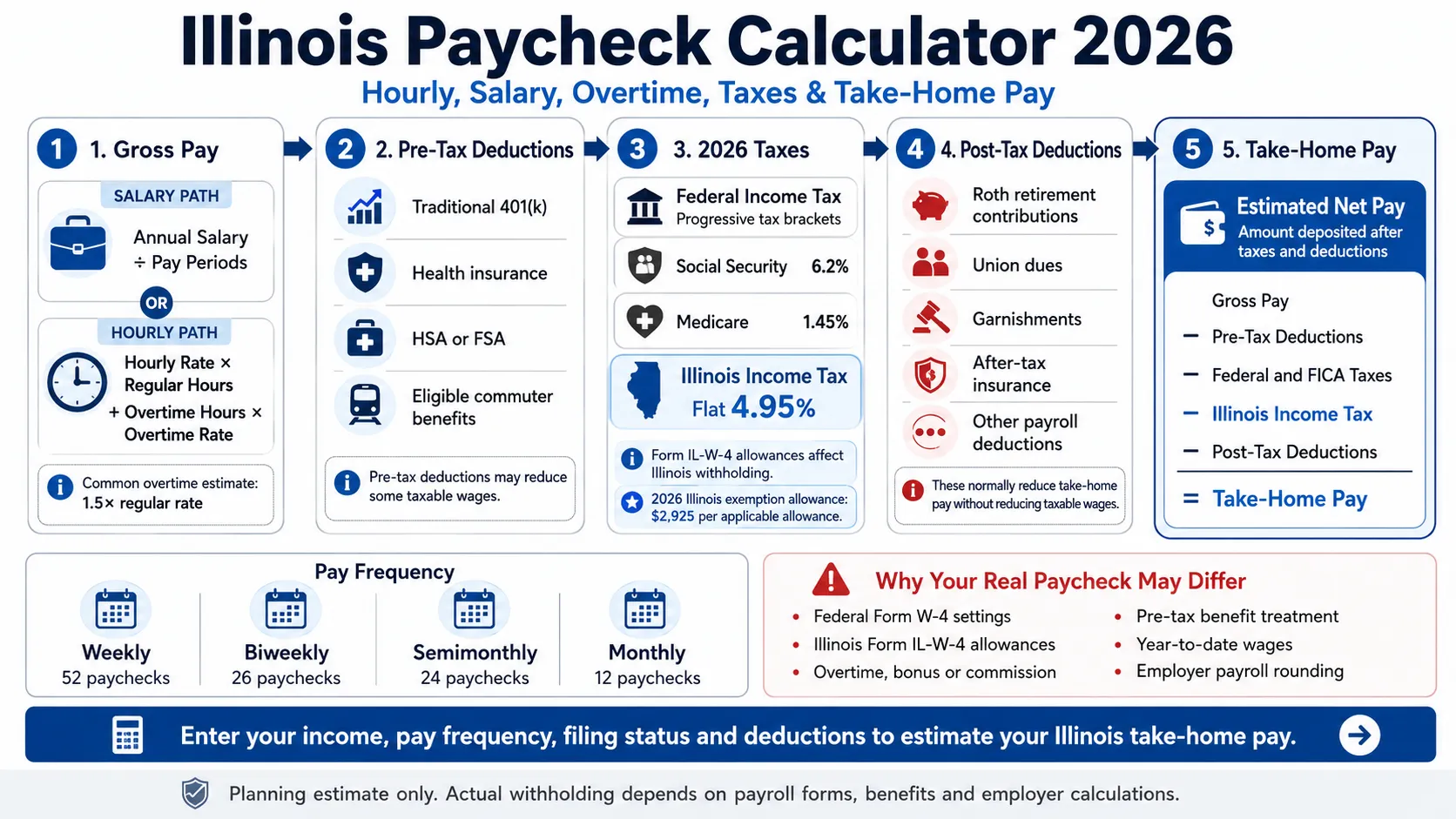
Illinois Paycheck Calculator With Taxes, Overtime, and Deductions
Use the fields that match your real payroll forms. Results update automatically and can also be refreshed using the calculate button.
Use the Paycheck Date to Choose the Correct Tax Year
Payroll forms follow the date wages are paid, not merely the period in which the work was performed. A paycheck issued in December 2025 uses 2025 payroll forms. A paycheck dated January 2, 2026 belongs to the 2026 payroll year even when some work was completed in December.
| Paycheck situation | Payroll year | What to use |
|---|---|---|
| Work completed in December and paid December 31, 2025 | 2025 | 2025 federal and Illinois payroll forms and tables |
| Work completed in December and paid January 2, 2026 | 2026 | 2026 federal and Illinois payroll forms and tables |
| Regular wages paid during 2026 | 2026 | 2026 Publication 15-T, IL-700-T, W-4, and IL-W-4 settings |
Review the official 2026 Illinois withholding forms page after confirming the paycheck date.
2026 IL-700-T Automated Withholding Formula
Illinois’s official automated method converts IL-W-4 allowances into a payroll-period exemption, subtracts that exemption from wages, multiplies the remaining taxable amount by 4.95%, and then adds the employee’s requested Line 3 amount.
Your Current Calculator Formula
See the complete 2026 IL-700-T withholding tables PDF after understanding the calculation above.
How Form IL-W-4 Changes an Illinois Paycheck
Form IL-W-4 is separate from federal Form W-4. It tells an Illinois employer how many basic and additional state allowances to use and whether to withhold an extra fixed amount each payday.
| IL-W-4 item | Paycheck effect | Employee action |
|---|---|---|
| Line 1 basic allowances | More valid allowances generally reduce Illinois withholding. | Use the basic allowance worksheet and enter only the number you choose to claim. |
| Line 2 additional allowances | Valid additional allowances further reduce withholding. | Use the worksheet for age, blindness, and eligible deductions or Illinois subtractions. |
| Line 3 extra withholding | Adds a fixed Illinois amount to each paycheck. | Use it when ordinary allowances are expected to leave too little withheld. |
| No completed or signed form | The employer generally withholds Illinois tax on compensation without allowances. | Provide a complete, signed form to payroll. |
| Allowance count decreases | A lower allowance count normally increases withholding. | A new form generally must be filed within 10 days when claimed allowances decrease. |
| Multiple jobs or working spouse | Claiming full allowances on every job can result in too little withholding. | The form suggests claiming allowances on the highest-paying job and zero on other IL-W-4 forms when appropriate. |
When Will a New IL-W-4 Affect My Paycheck?
An employer may apply a change immediately, but Illinois instructions do not always require an existing form change to be implemented on the next paycheck. Depending on when it is filed, the employer may have until the first payment after the next qualifying calendar-quarter date.
Federal Exemption Does Not Automatically Mean Illinois Exemption
A worker who qualifies to claim exemption on federal Form W-4 can still have Illinois tax due. Illinois exemption must be separately supported under the IL-W-4 instructions. Leaving Lines 1 through 3 blank is not the same as correctly claiming exemption.
Review the official Form IL-W-4 and allowance worksheet PDF after reading these practical steps.
Federal Form W-4 Fields That Commonly Change Net Pay
| W-4 entry | What it changes | Common mistake |
|---|---|---|
| Step 1 filing status | Selects the federal withholding schedule. | Using a tax-return status that does not match the W-4 on file. |
| Step 2 multiple jobs | Increases withholding when a household has multiple wage jobs. | Ignoring a second job or a working spouse. |
| Step 3 credits | Reduces projected annual federal withholding. | Entering a dependent count instead of the annual dollar amount. |
| Step 4(a) other income | Increases withholding for income not normally subject to paycheck withholding. | Adding salary from the same job a second time. |
| Step 4(b) deductions | Reduces estimated federal withholding when eligible deductions exceed the standard deduction. | Entering the full standard deduction rather than the worksheet result. |
| Step 4(c) extra withholding | Adds a fixed federal amount to each paycheck. | Entering an annual amount when payroll expects an amount per pay period. |
Use the official 2026 Form W-4 PDF and 2026 Publication 15-T PDF for exact federal payroll instructions.
Illinois Tax Impact With and Without State Withholding
This comparison isolates Illinois withholding. It is useful for supported reciprocity, relocation planning, or checking why an employer removed the Illinois line from a paycheck.
| Scenario | Estimated paycheck | Estimated monthly take-home | Meaning |
|---|---|---|---|
| Illinois withholding included | $0 | $0 | Uses 4.95%, entered allowances, and Line 3 extra withholding. |
| Illinois withholding excluded | $0 | $0 | Comparison only; another resident state may still tax the wages. |
| Estimated difference | $0 | $0 | Shows estimated Illinois withholding impact, not final annual liability. |
Illinois Hourly Pay, Overtime, Bonuses, Tips, and Paid Leave
Regular and overtime hours
Many nonexempt Illinois employees receive time-and-a-half after more than 40 hours in the employer’s workweek. Enter regular and overtime hours separately rather than multiplying all hours by one rate.
Exempt classifications and special wage rules can apply. The calculator lets you choose a multiplier, but it does not decide whether a worker is legally overtime-eligible.
Bonus, commission, and tips
Add expected annual supplemental wages to estimate yearly take-home pay. A separate bonus check may show different federal withholding because payroll can use supplemental-wage or aggregate methods.
Illinois withholding still generally applies at 4.95% after applicable state withholding adjustments. Social Security and Medicare can also apply.
Paid Leave for All Workers Is Not a Separate State Payroll Tax
Illinois Paid Leave for All Workers rules can provide eligible employees paid leave accrual, but the program is not a statewide employee payroll-tax deduction comparable to some state paid-family- leave programs. A paystub line labeled leave, PTO, or absence should be reviewed according to the employer’s plan.
Check the Illinois overtime FAQ and Paid Leave for All Workers FAQ after reviewing your own hours and classification.
Illinois Reciprocity and Nonresident Workday Rules
Illinois has reciprocal wage agreements with Iowa, Kentucky, Michigan, and Wisconsin. A qualifying resident of one of these states can give an Illinois employer Form IL-W-5-NR so Illinois wage withholding is not taken.
Nonresident Employees Working More Than 30 Days in Illinois
A nonresident expected to perform non-incidental services in Illinois for more than 30 working days may be asked to complete 2026 Form IL-W-6. The employee may also need to record Illinois work dates and addresses on Form IL-W-6-WS.
A day generally counts as an Illinois working day when more work time is spent performing duties in Illinois than outside Illinois, excluding travel time, or when the only service performed is travel to an Illinois destination and arrival occurs that day.
| Situation | Common form | Practical payroll action |
|---|---|---|
| Reciprocal-state resident receiving Illinois wages | IL-W-5-NR | File with the Illinois employer to claim supported nonresident treatment. |
| Nonresident expected to work over 30 Illinois days | IL-W-6 | Complete when requested, generally before the first Illinois workday or as soon as practicable. |
| Tracking actual Illinois dates and locations | IL-W-6-WS | Record dates and work addresses and submit the completed 2026 worksheet to the employer by January 1, 2027. |
| Illinois resident working from Illinois for an out-of-state employer | Payroll review / estimated payments | Review Illinois withholding when working from home or at Illinois locations for more than 30 working days. |
Use the official Form IL-W-5-NR PDF, 2026 Form IL-W-6 PDF, and 2026 IL-W-6-WS PDF after identifying which situation applies.
Illinois Paystub Decoder: Which Wage Number Should Match?
Gross pay, federal taxable wages, Social Security wages, Medicare wages, and Illinois taxable wages can all be different on the same paycheck. Comparing only gross pay with every tax line can make a correct payroll result look wrong.
| Paystub line | What it usually represents | Why it may differ |
|---|---|---|
| Gross pay | Regular wages, overtime, bonus, tips, and other taxable or nontaxable pay before deductions. | Some reimbursements and employer-paid benefits may not be taxable wages. |
| Federal taxable wages | Wages subject to federal income-tax withholding. | Traditional retirement and eligible benefits can reduce this number. |
| Social Security wages | Wages subject to the 6.2% employee Social Security tax. | Traditional 401(k) contributions generally do not reduce these wages, while some cafeteria-plan benefits can. |
| Medicare wages | Wages subject to Medicare tax. | There is no ordinary Medicare wage cap, and additional withholding can begin above $200,000. |
| Illinois taxable wages | Compensation used for Illinois withholding after applicable payroll treatment. | Illinois conformity, pre-tax benefits, retirement treatment, and reciprocity can matter. |
| Illinois tax withheld | The state amount sent through payroll. | IL-W-4 allowances, Line 3, wage tables, pay frequency, and rounding affect the amount. |
Which Deductions Reduce Which Taxes?
| Deduction | Common paycheck treatment | What to verify |
|---|---|---|
| Traditional 401(k) or 403(b) | Often reduces federal and Illinois income-tax wages but generally not FICA wages. | Compare federal, Social Security, Medicare, and Illinois taxable wage lines. |
| Roth retirement contribution | Normally post-tax for federal and Illinois income-tax purposes. | Do not enter it as traditional retirement. |
| Health, dental, or vision premium | May be pre-tax under an eligible cafeteria plan. | Check whether it reduces income-tax wages, FICA wages, or both. |
| HSA or FSA | Payroll contributions can receive favorable tax treatment when eligibility rules are met. | Plan type, annual limits, and employer payroll coding. |
| Commuter benefit | Eligible transit or parking benefits may be excluded up to applicable federal limits. | Enter only the payroll deduction, not total commuting expenses. |
| Union dues or garnishment | Often deducted after taxes. | Check the deduction order and whether it changes taxable wage boxes. |
Illinois Job Offer and Housing Affordability Calculator
Gross salary alone cannot show whether an offer supports housing, utilities, commuting, benefits, debt, food, savings, and other recurring costs.
2026 Federal and Illinois Paycheck Numbers
| Item | 2026 amount | How this page uses it |
|---|---|---|
| Federal standard deduction | $16,100 single, $32,200 joint, $24,150 head of household | Reduces annual federal taxable income in the planning estimate. |
| Federal marginal rates | 10%, 12%, 22%, 24%, 32%, 35%, and 37% | Applied progressively; the highest bracket does not apply to every dollar. |
| Social Security | 6.2% employee rate up to $184,500 | Caps estimated employee Social Security tax at the annual wage base. |
| Medicare | 1.45%, plus 0.9% withholding above $200,000 | Applied to estimated Medicare wages without the ordinary Social Security wage cap. |
| Illinois withholding rate | 4.95% | Applied after estimated Illinois allowance amounts and eligible pre-tax items. |
| IL-W-4 Line 1 allowance | $2,925 each | Reduces estimated annual Illinois taxable wages. |
| IL-W-4 Line 2 allowance | $1,000 each | Provides the additional allowance reduction in the automated method. |
2025 vs 2026 Illinois Paycheck Changes
| Input | 2025 | 2026 | Why it changes net-pay estimates |
|---|---|---|---|
| Federal standard deduction — single | $15,750 | $16,100 | An older calculator can overstate 2026 federal taxable income. |
| Federal standard deduction — joint | $31,500 | $32,200 | Joint-filer estimates should use the correct payroll year. |
| Social Security wage base | $176,100 | $184,500 | Higher earners can pay Social Security tax on more wages in 2026. |
| Illinois Line 1 allowance value | $2,850 | $2,925 | The allowance amount directly changes estimated Illinois taxable wages. |
| Illinois withholding rate | 4.95% | 4.95% | The rate stayed the same, but federal inputs and Illinois allowances changed. |
Biweekly vs Semimonthly Pay
Biweekly means 26 checks per year. Semimonthly normally means 24. The same annual salary produces a larger semimonthly check because it is divided by fewer pay periods.
Biweekly: 26 Semimonthly: 24Marginal Rate vs Average Reduction
A federal marginal bracket applies only to the dollars inside that bracket. The calculator’s total-reduction percentage includes taxes, retirement, benefits, extra withholding, and post-tax deductions, so it is not your marginal tax rate.
Marginal ≠ all income Net reduction includes deductionsCommon Illinois Salary After-Tax Examples
These dynamic examples assume single filing status, biweekly pay, one IL-W-4 Line 1 allowance, no additional Illinois allowances, no benefits, and no retirement contribution.
| Annual salary | Estimated biweekly take-home | Estimated monthly take-home | Useful next check |
|---|---|---|---|
| $40,000 | $0 | $0 | Health premiums, housing, transportation, and debt |
| $50,000 | $0 | $0 | Retirement contribution and IL-W-4 allowances |
| $75,000 | $0 | $0 | Housing ratio, benefits, and W-4 Step 2 |
| $100,000 | $0 | $0 | Bonus pay, credits, extra withholding, and savings |
| $150,000 | $0 | $0 | Social Security wage base, Medicare, and supplemental pay |
Why Your Real Illinois Paycheck May Not Match
- The selected pay frequency is wrong: biweekly and semimonthly are not interchangeable.
- Your employer has different federal W-4 filing, multiple-jobs, credit, deduction, or extra-withholding entries.
- The IL-W-4 Line 1, Line 2, or Line 3 values do not match payroll records.
- A new IL-W-4 has been submitted but has not yet taken effect in payroll.
- Payroll has no valid IL-W-4 and is withholding with no Illinois allowances.
- Reciprocity applies, but Form IL-W-5-NR has not been processed.
- A reciprocal resident state is withholding tax even though Illinois withholding is zero.
- Traditional retirement was entered as Roth, or Roth was entered as pre-tax.
- A health, HSA, FSA, or commuter deduction affects different wage bases than expected.
- The check includes overtime, bonus, commission, tips, retro pay, severance, or reimbursement.
- Social Security withholding changed after cumulative wages reached the annual wage base.
- The first or final paycheck covers only part of a pay period.
- Payroll uses exact wage tables, pay-date logic, cents, and employer rounding.
Eight-Step Paystub Reconciliation
Official Sources Used for This 2026 Calculator
Use these documents after identifying the exact issue. They are grouped by the decision they help you make instead of presented as an unexplained link list.
Illinois Paycheck Calculator FAQs
How much is my paycheck after taxes in Illinois?
Enter salary or hourly wages, overtime, pay frequency, W-4 settings, IL-W-4 allowances, retirement, benefits, and other deductions. The calculator estimates take-home pay per paycheck, per month, and per year.
What is the Illinois withholding rate for 2026?
The general Illinois payroll withholding rate is 4.95%. Payroll first accounts for applicable IL-W-4 allowance amounts and then adds any extra Illinois withholding requested on Line 3.
How do IL-W-4 Line 1 and Line 2 allowances work?
For the 2026 automated method, each Line 1 allowance represents $2,925 and each Line 2 additional allowance represents $1,000 when calculating the employee’s withholding exemption.
What happens if I do not submit a valid IL-W-4?
If a completed and signed IL-W-4 is not on file, or the form is incomplete or altered, the employer generally withholds Illinois income tax without allowing exemptions.
When does a new IL-W-4 take effect?
An employer may apply a change immediately, but may not always be required to do so on the next paycheck. The effective date can depend on the next calendar-quarter date and when the form was filed.
Does federal W-4 exemption also exempt me from Illinois withholding?
No. Federal and Illinois exemption rules are separate. A worker who owes no federal income tax can still owe Illinois income tax and may still need Illinois withholding.
Can I calculate hourly pay and overtime in Illinois?
Yes. Select hourly pay and enter the hourly rate, regular weekly hours, overtime hours, overtime multiplier, and paid workweeks. The calculator adds overtime before estimating taxes and deductions.
What is the difference between biweekly and semimonthly pay?
Biweekly pay normally means 26 checks per year. Semimonthly pay normally means 24. The same annual salary therefore produces different individual paycheck amounts.
Does a traditional 401(k) reduce Illinois withholding?
A traditional pre-tax retirement contribution can reduce federal and Illinois income-taxable wages, but it generally does not reduce Social Security or Medicare wages. Actual plan and payroll treatment controls.
Which states have wage reciprocity with Illinois?
Illinois has reciprocal wage agreements with Iowa, Kentucky, Michigan, and Wisconsin. Qualifying residents generally provide Form IL-W-5-NR to the Illinois employer.
What is the Illinois 30-working-day rule for nonresidents?
A qualifying nonresident expected to perform non-incidental services in Illinois for more than 30 working days may need Form IL-W-6 and a record of Illinois work dates and locations on IL-W-6-WS.
Does Chicago have a separate city wage income tax?
A standard Illinois employee paycheck does not normally include a separate Chicago municipal wage-income-tax line. Housing, sales taxes, transportation, and other local costs can still affect affordability.
Why does ADP or my payroll portal show a different amount?
Employer payroll uses the exact W-4, IL-W-4, year-to-date wages, taxable benefit codes, pay date, wage tables, reciprocity records, supplemental-pay methods, and rounding. This calculator provides an annual planning estimate.
Should I use a 2025 or 2026 Illinois paycheck calculator?
Use the year in which the wages are paid. A paycheck dated in 2026 uses 2026 payroll inputs even when some work was performed during 2025.
Can this calculator replace official payroll tables or tax advice?
No. It cannot replace IRS Publication 15-T, Illinois IL-700-T, employer payroll software, official tax forms, legal advice, or professional payroll and tax guidance.
Recalculate Before a Job, Lease, or Payroll Change
Run the calculator again whenever salary, hourly schedule, overtime, W-4 entries, IL-W-4 allowances, reciprocity, benefits, retirement contributions, housing, or monthly costs change.
Calculate Illinois Pay Again