
North Carolina Paycheck Calculator 2026
Estimate your North Carolina net pay from annual salary or hourly wages after federal tax, Social Security, Medicare, NC income tax, retirement contributions, benefits, overtime, extra withholding, and post-tax deductions.
Quick Answer: How North Carolina Take-Home Pay Works
A North Carolina paycheck starts with gross salary, hourly wages, overtime, bonus, commission, or tips. Payroll then subtracts federal withholding, Social Security, Medicare, North Carolina withholding, eligible benefits, retirement contributions, extra withholding, and post-tax deductions.
For 2026, North Carolina’s final individual income-tax rate is 3.99%, while the official NC-30 percentage and annualized payroll methods use 4.09%—the 3.99% rate plus 0.1%. Your NC-4 allowance count, filing status, pay frequency, and additional withholding can change the amount taken from each check.
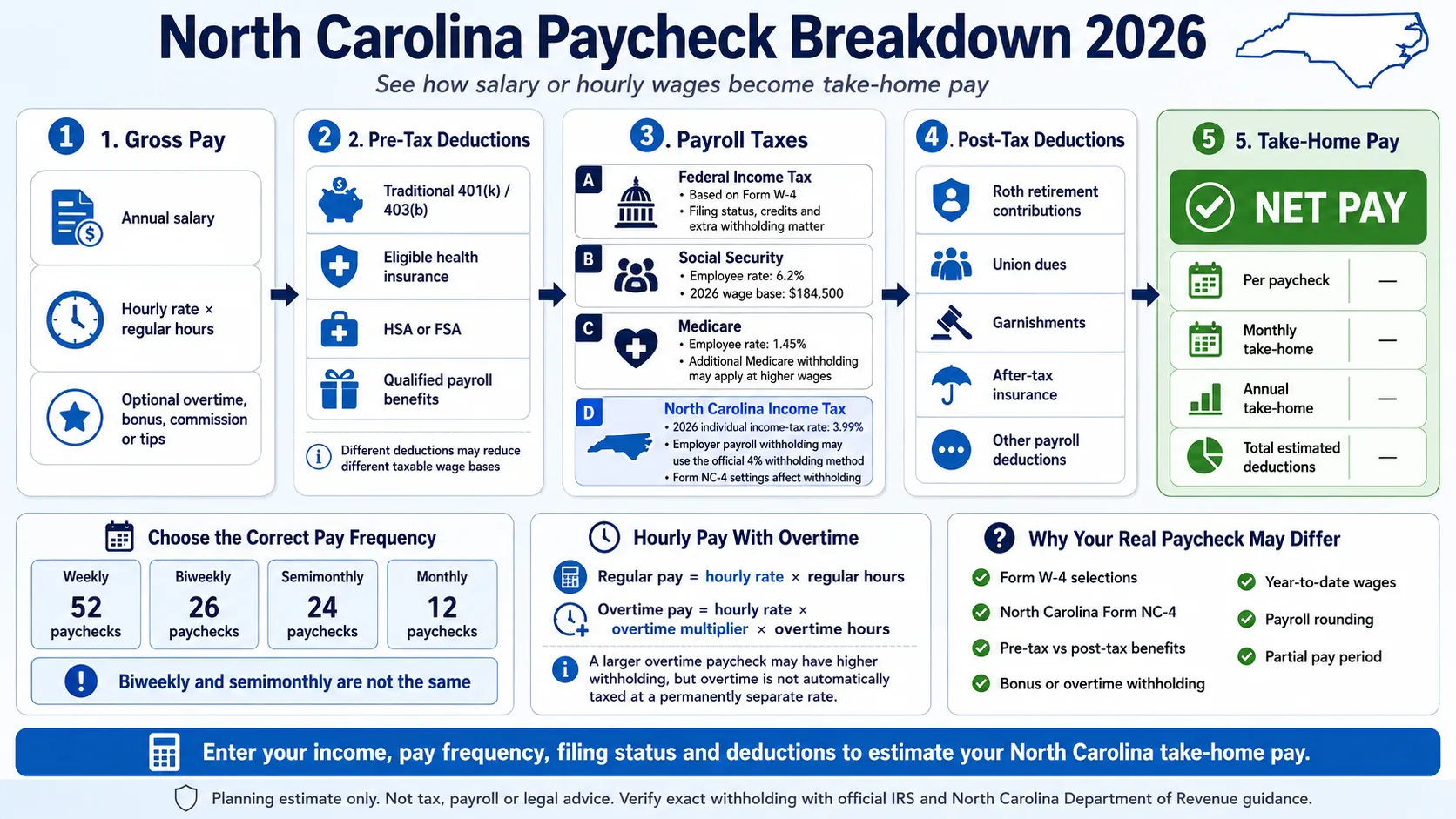
North Carolina Paycheck Calculator With Taxes and Deductions
Enter the details that match your real job. The calculator can model salary, hourly wages, overtime, bonus income, payroll withholding, retirement, benefits, monthly budget, and common deductions.
North Carolina Paycheck Withholding vs Final State Tax
The official 2026 NC-30 percentage method uses 4.09% after the applicable standard deduction and NC-4 allowances. The final 2026 individual income-tax rate is 3.99%. This comparison shows why paycheck withholding can be slightly higher than an annual liability estimate.
| Scenario | Estimated paycheck | Estimated monthly take-home | Practical meaning |
|---|---|---|---|
| NC-30 paycheck withholding mode — 4.09% | $0 | $0 | Models the official percentage-method rate and NC-4 allowances for paycheck planning. |
| Annual North Carolina tax mode — 3.99% | $0 | $0 | Models final state tax before credits and return-specific adjustments. |
| Estimated withholding difference | $0 | $0 | A small difference does not include every NC-4 allowance, credit, addition, deduction, or payroll-table rule. |
Monthly North Carolina Budget From Your Paycheck
Convert the estimated annual net pay into a monthly decision number before comparing rent, debt, bills, and savings.
North Carolina Job Offer and Housing Affordability Calculator
Test a salary offer against the recurring costs that determine how much of the advertised salary is actually usable.
Choose the North Carolina Paycheck Calculation You Actually Need
Different paycheck questions require different inputs. Start with the task that matches your real decision rather than relying on one generic tax percentage.
How the 2026 North Carolina Paycheck Calculation Works
The calculator annualizes gross wages, separates federal and FICA wage bases, applies the selected North Carolina method, subtracts deductions, and divides annual net pay by the chosen payroll frequency.
| Paycheck component | Planning method used here | Why an employer result may differ |
|---|---|---|
| Federal income tax | 2026 annual brackets, federal standard deduction, entered W-4 credits, and optional federal-only deduction. | Payroll uses Publication 15-T, the stored Form W-4, exact pay-period wages, and rounding. |
| Social Security | 6.2% of estimated Social Security wages up to the $184,500 2026 wage base. | Year-to-date wages and benefit tax treatment determine when the cap is reached. |
| Medicare | 1.45% of Medicare wages plus 0.9% employee withholding above $200,000. | Joint-return liability and employer withholding thresholds are not identical. |
| NC paycheck withholding | 4.09% × annualized NC wages after the selected standard deduction, $2,500 per NC-4 allowance, and entered NC adjustment. | An employer may use wage-bracket, percentage, annualized-wage, or another substantially similar method and rounds the final amount. |
| NC annual tax estimate | 3.99% of estimated North Carolina taxable income before return-specific credits. | Withholding is a prepayment; final liability depends on the tax return, credits, additions, deductions, and income from all sources. |
| Benefits and other deductions | Traditional retirement, pre-tax benefits, post-tax items, and additional withholding are kept separate. | Plan documents determine whether a deduction reduces federal, NC, Social Security, Medicare, or none of those wage bases. |
Information to Check Before Calculating Your NC Paycheck
| Information | Where to find it | Why it changes the result |
|---|---|---|
| Gross salary or hourly rate | Offer letter, employment agreement, or paystub | This is the starting point for gross-to-net calculations. |
| Pay frequency | Payroll calendar or recent paystub | Weekly, biweekly, semimonthly, and monthly schedules divide annual pay differently. |
| Federal Form W-4 | Employer payroll or HR portal | Filing status, credits, deductions, other income, and extra withholding affect federal tax. |
| North Carolina Form NC-4 or NC-4 EZ | Employer onboarding or payroll records | State allowance and withholding choices affect NC payroll withholding. |
| Benefit tax treatment | Benefits guide and taxable-wage lines on the paystub | Health, HSA, FSA, retirement, and insurance items can affect different tax bases. |
| Overtime or special pay | Timesheet, commission plan, bonus notice, or paystub | Special earnings can use different payroll withholding methods. |
NC-4, NC-4 EZ, or NC-4 NRA: Which Withholding Form Should You Use?
Federal Form W-4 does not replace a North Carolina withholding certificate. North Carolina employees generally give the employer an NC-4, NC-4 EZ, or—when applicable—NC-4 NRA so payroll can calculate state withholding.
| Form | Who commonly uses it | What to check before submitting |
|---|---|---|
| Federal Form W-4 | Employees subject to federal wage withholding. | Federal filing status, multiple jobs, dependents or credits, other income or deductions, and extra withholding. |
| North Carolina Form NC-4 | Employees who need the detailed allowance worksheet for NC adjustments, itemized deductions, child deduction, or tax credits. | Allowance count, filing status, NC-specific deductions or additions, credits, and Line 2 additional withholding. |
| North Carolina Form NC-4 EZ | Eligible employees planning to claim the NC standard deduction or child deduction, no other NC deductions, no NC credits, or a listed exemption. | Whether the simplified form truly fits; otherwise complete the full NC-4. |
| North Carolina Form NC-4 NRA | A nonresident alien employee under the form’s federal residency tests. | Single-status payroll treatment, the required additional amount, treaty rules, and specific NRA instructions. |
What happens if no North Carolina form is on file?
The official instructions state that the employer must withhold as if the employee is single with no allowances. That default can make a paycheck smaller than an estimate that assumes a different filing status or allowance count.
Two or more jobs
The NC-4 instructions say withholding is usually most accurate when all allowances are claimed on the higher-paying job and zero allowances are claimed on the other job. The Multiple Jobs Table can indicate an additional Line 2 amount.
Nonwage income
Interest, dividends, self-employment income, or other income may not be covered by wage withholding. The official NC-4 instructions direct taxpayers to consider estimated payments using Form NC-40 when needed.
How the Official 2026 NC-30 Withholding Formula Changes a Paycheck
The NC-30 employer publication provides wage-bracket, percentage, and annualized-wage methods. Its percentage and annualized methods use the 3.99% individual rate plus 0.1%, producing a 4.09% withholding rate, and instruct employers to round the final withholding amount to the nearest whole dollar.
North Carolina Standard Deduction, Itemized Deductions, and Child Deduction
Do not copy the federal standard deduction into the North Carolina calculation. North Carolina uses its own deduction amounts and permits only specified itemized deductions. There is no additional NC standard deduction solely for being age 65 or older or blind.
| NC filing status | NC standard deduction | Practical paycheck use |
|---|---|---|
| Single or married filing separately | $12,750 | Used in the NC-30 formula unless a different valid setup applies. |
| Married filing jointly or surviving spouse | $25,500 | Use the joint amount only when the selected state filing status supports it. |
| Head of household | $19,125 | The NC-30 pay-period deduction is larger than the single amount. |
| Married filing separately when spouse itemizes | $0 | A generic standard-deduction estimate can overstate take-home pay in this situation. |
NC child deduction can change the NC-4 allowance count
North Carolina provides a child deduction of up to $3,000 per qualifying child, with the amount reduced as adjusted gross income rises. NC-4 and NC-4 EZ convert eligible child-deduction amounts into withholding allowances; the calculator therefore asks for the allowance count shown on the form rather than guessing from the number of children.
Which Payroll Deductions Reduce Which Taxes?
| Deduction | Common payroll treatment | Practical action |
|---|---|---|
| Traditional 401(k), 403(b), or similar plan | Often reduces federal and NC income-taxable wages but generally not Social Security or Medicare wages. | Compare federal taxable wages with Social Security wages on the paystub. |
| Roth retirement contribution | Usually post-tax for income-tax purposes. | Enter it as post-tax rather than traditional retirement. |
| Health, dental, or vision insurance | Often pre-tax through an eligible employer plan, but treatment can vary. | Check whether the deduction reduces federal, NC, Social Security, and Medicare wages. |
| HSA or FSA | Often pre-tax when contributed through a qualifying payroll arrangement. | Verify eligibility, annual limits, and FICA treatment. |
| Commuter or parking benefit | May receive favorable payroll-tax treatment up to applicable limits. | Use the payroll deduction amount rather than total commuting cost. |
| Union dues or garnishment | Often deducted after taxes. | Enter the actual per-paycheck amount as post-tax. |
| Extra withholding | Reduces current take-home pay but is not a benefit expense. | Enter federal and NC extra withholding separately. |
| Employer unemployment or workers’ compensation cost | Normally an employer cost rather than an employee income-tax deduction. | Do not subtract employer payroll costs unless the paystub shows a valid employee deduction. |
North Carolina Overtime, Bonus, Commission, Tips, and Supplemental Wages
Hourly overtime: calculate by workweek
For a covered nonexempt employee, overtime is generally based on hours worked over 40 in a workweek at one and one-half times the regular rate. Each workweek stands on its own, even when the employer pays biweekly or semimonthly.
Exempt status, regular-rate rules, tipped work, commissions, bonuses, and public-sector comp time can require a different legal analysis. The calculator lets you enter a multiplier but does not decide whether a worker is legally overtime-eligible.
Separate supplemental-wage checks
The 2026 NC-30 instructions allow an employer that withholds from regular wages to use a flat 4.09% North Carolina rate on separately identified supplemental wages, or combine the supplemental and regular wages and use the aggregate method.
Tips reported to an employer can also be treated as supplemental wages for North Carolina withholding. Federal, Social Security, Medicare, and benefit deductions remain separate calculations.
Quick NC Separate Bonus Check
Use this only to preview the North Carolina 4.09% supplemental withholding plus employee FICA. It intentionally does not guess federal income-tax withholding or employer-specific deductions.
2026 Paycheck Numbers Used in This Calculator
| 2026 item | Amount or rule | How this calculator uses it |
|---|---|---|
| Federal standard deduction | $16,100 single, $32,200 married filing jointly, and $24,150 head of household | Reduces estimated federal taxable income. |
| Federal marginal tax rates | 10%, 12%, 22%, 24%, 32%, 35%, and 37% | Applied progressively to estimated annual federal taxable income. |
| Social Security wage base | $184,500 | Caps wages subject to the 6.2% employee Social Security estimate. |
| Medicare | 1.45%, plus 0.9% employee withholding above $200,000 | Applied to estimated Medicare wages. |
| NC individual income-tax rate | 3.99% for taxable years after 2025 | Available in annual-liability mode. |
| NC payroll withholding rate | 4.09% in the 2026 NC-30 percentage method | Default paycheck-withholding mode. |
| NC standard deduction | $12,750 single, $25,500 married filing jointly, and $19,125 head of household | Reduces estimated NC taxable wages before the planning rate is applied. |
2026 vs 2025 North Carolina Paycheck Calculations
| Item | 2025 reference | 2026 planning input | Why it matters |
|---|---|---|---|
| NC individual income-tax rate | 4.25% | 3.99% | A calculator locked to 2025 can overstate annual NC income-tax liability. |
| NC payroll withholding method | Prior-year employer instructions | 2026 NC-30 method and 4.09% rate | Paycheck withholding is not always identical to final annual liability. |
| Federal standard deduction — single | $15,750 | $16,100 | Using the old deduction can overstate 2026 federal taxable income. |
| Social Security wage base | $176,100 | $184,500 | Higher earners can pay Social Security tax on more wages in 2026. |
Biweekly vs semimonthly pay in North Carolina
Biweekly pay normally means 26 checks per year. Semimonthly pay normally means 24 checks. The annual salary may be identical, but the per-check amount differs.
Biweekly: 26 checksSemimonthly: 24 checksHourly vs salary paycheck
Hourly workers should calculate regular wages and overtime separately. Salaried workers should enter annual base salary and add expected bonus, commission, or tip income.
Hourly: rate × hoursSalary: annual compensationNorth Carolina Salary After Tax Examples
These dynamic examples assume a single filer, biweekly pay, NC payroll-withholding mode, and no retirement or benefit deductions. Use the main calculator for your own situation.
| Common salary search | Estimated biweekly take-home | Estimated monthly take-home | What to check next |
|---|---|---|---|
| $40,000 salary after taxes in NC | $0 | $0 | Housing, health premiums, commuting, debt, and credits. |
| $50,000 salary after taxes in NC | $0 | $0 | Benefits, retirement percentage, and NC-4 setup. |
| $75,000 salary after taxes in NC | $0 | $0 | Housing ratio, savings, and job-offer costs. |
| $100,000 salary after taxes in NC | $0 | $0 | W-4 credits, extra withholding, and retirement. |
| $150,000 salary after taxes in NC | $0 | $0 | Social Security wage base, bonus pay, and Medicare. |
North Carolina Resident, Nonresident, Remote-Work, and Moving Rules
North Carolina withholding can apply to wages paid to North Carolina residents regardless of where earned and to nonresidents for services performed in North Carolina. A paycheck calculator cannot determine domicile or allocate part-year income from a few fields, so use the cards below as a payroll checklist.
Why ADP or Another Payroll Calculator May Show a Different Result
| Possible difference | General planning calculator | Employer payroll system |
|---|---|---|
| W-4 details | Uses the filing status, credits, deductions, and extra withholding entered here. | Uses the exact W-4 stored in the employee profile. |
| NC withholding form | Uses the selected 4.09% or 3.99% mode and an editable NC deduction. | May use exact NC-4 allowances and official NC-30 wage-bracket or percentage tables. |
| Year-to-date wages | Models a full year from current inputs. | Knows prior checks, Social Security wages, and annual deduction totals. |
| Benefit setup | Uses the tax treatment selected by the user. | Knows the employer plan’s precise federal, NC, and FICA treatment. |
| Special pay | Annualizes bonus, tips, commission, and overtime. | May use supplemental-wage, aggregate, retro-pay, or special payroll methods. |
| Rounding and pay date | Uses annual estimates divided by pay frequency. | Applies exact payroll dates, cents, table rounding, and employer rules. |
Why Your Real North Carolina Paycheck May Not Match
- Weekly, biweekly, semimonthly, or monthly pay frequency was selected incorrectly.
- The calculator is using 4.09% withholding mode while you are comparing final 3.99% annual liability, or vice versa.
- Your federal Form W-4 filing status, Step 2 election, credits, deductions, or extra withholding differ.
- Your North Carolina NC-4, NC-4 EZ, or NC-4 NRA settings differ from the planning inputs.
- Traditional retirement was entered as Roth, or a Roth contribution was entered as pre-tax.
- A health, HSA, FSA, or other benefit reduces different taxable wage boxes than expected.
- The paycheck includes overtime, bonus, commission, tips, retroactive pay, severance, or reimbursement.
- Payroll software uses year-to-date wages and official tables for the actual pay date.
- Social Security tax changed after cumulative wages reached the annual wage base.
- The first or final check covers only part of a pay period.
How to Match This Estimate With Your Real Paystub
Official North Carolina and Federal Paycheck Sources
Use the explanation above to identify the correct source, then open only the document needed for your form, withholding method, or paystub question.
North Carolina Paycheck Calculator FAQs
How much is my paycheck after taxes in North Carolina?
Enter salary or hourly wages, pay frequency, federal filing status, NC-4 allowances, North Carolina calculation mode, retirement, benefits, deductions, and extra withholding. The calculator estimates net pay per paycheck, per month, and per year.
What is the North Carolina income-tax rate for 2026?
The final individual income-tax rate for tax year 2026 is 3.99%. The official NC-30 percentage and annualized paycheck-withholding methods use 4.09%, which is the 3.99% rate plus 0.1%.
Why does the calculator offer both 4.09% and 3.99% North Carolina modes?
Use 4.09% to approximate paycheck withholding under the 2026 NC-30 percentage method. Use 3.99% to estimate annual state income-tax liability before return-specific credits and adjustments.
What happens if I do not submit Form NC-4, NC-4 EZ, or NC-4 NRA?
The official instructions state that the employer must withhold as if you are single with no allowances. Federal Form W-4 is not a substitute for a North Carolina withholding certificate.
Should I use NC-4 or NC-4 EZ?
NC-4 EZ is for eligible employees using the North Carolina standard deduction or child deduction, no other NC deductions, no NC tax credits, or a listed exemption. Use the full NC-4 when you need the detailed worksheet for other deductions, adjustments, credits, or multiple jobs.
How do NC-4 allowances change my paycheck?
The 2026 NC-30 percentage method subtracts $2,500 from annualized North Carolina wages for each withholding allowance before applying 4.09%. Enter the allowance count from your current state form.
How should I handle two jobs on Form NC-4?
The NC-4 instructions say withholding is usually most accurate when allowances are claimed on the higher-paying job and zero allowances are claimed on the other. The Multiple Jobs Table may also indicate extra withholding for Line 2.
Can I calculate hourly pay and overtime in North Carolina?
Yes. Enter regular weekly hours, overtime hours, the applicable multiplier, and paid workweeks. The tool estimates pay but does not determine whether a worker is legally nonexempt or eligible for overtime.
How is a separate bonus or commission check withheld in North Carolina?
When the NC-30 conditions are met, an employer may withhold a flat 4.09% from separately identified supplemental wages or use an aggregate method that combines supplemental and regular wages.
What is the difference between biweekly and semimonthly pay?
Biweekly pay normally means 26 paychecks per year, while semimonthly pay normally means 24. The annual salary can be identical, but gross pay and deductions per check differ.
Does a traditional 401(k) reduce North Carolina paycheck taxes?
A traditional retirement contribution commonly reduces federal and North Carolina income-taxable wages, but it generally does not reduce Social Security or Medicare wages. Actual plan treatment controls.
Why does ADP or my employer payroll portal show a different amount?
Employer payroll can use the exact W-4, NC-4 allowance count, wage-bracket or percentage table, year-to-date wages, benefit tax treatment, special earnings, pay date, and rounding. This tool uses planning estimates.
What if I live outside North Carolina but work in the state?
Wages for services performed in North Carolina can be subject to North Carolina withholding and nonresident filing rules. Review your work location, residence, payroll coding, and any part-year or other-state credit issues.
Should I use a 2025 or 2026 North Carolina paycheck calculator?
Use the year in which the wages are paid. The NC rate, NC-30 formula, federal brackets and standard deductions, Social Security wage base, and payroll guidance can change by year.
Can this calculator replace official payroll tables or tax advice?
No. It is a planning estimate and cannot replace the 2026 NC-30 tables, Form NC-4 instructions, IRS Publication 15-T, employer payroll software, tax preparation, legal advice, or professional payroll guidance.
Related Paycheck Calculators
No internal article links were added because the live post sitemap could not be retrieved and verified during this refresh. This avoids guessed URLs, redirects, and unrelated links.
Estimate Your North Carolina Take-Home Pay Before Payday
Recalculate whenever salary, hourly schedule, overtime, Form W-4, NC-4, benefits, retirement, housing, or monthly budget changes. Use the result before accepting a job, signing a lease, changing deductions, or planning savings.
Run the NC Calculator Again