
Florida Paycheck Calculator 2026
Estimate Florida take-home pay by pay date, salary or hourly wages, overtime, cash tips, bonus pay, Form W-4 settings, FICA, benefits, retirement, and other deductions.
Quick Answer: What Comes Out of a Florida Paycheck?
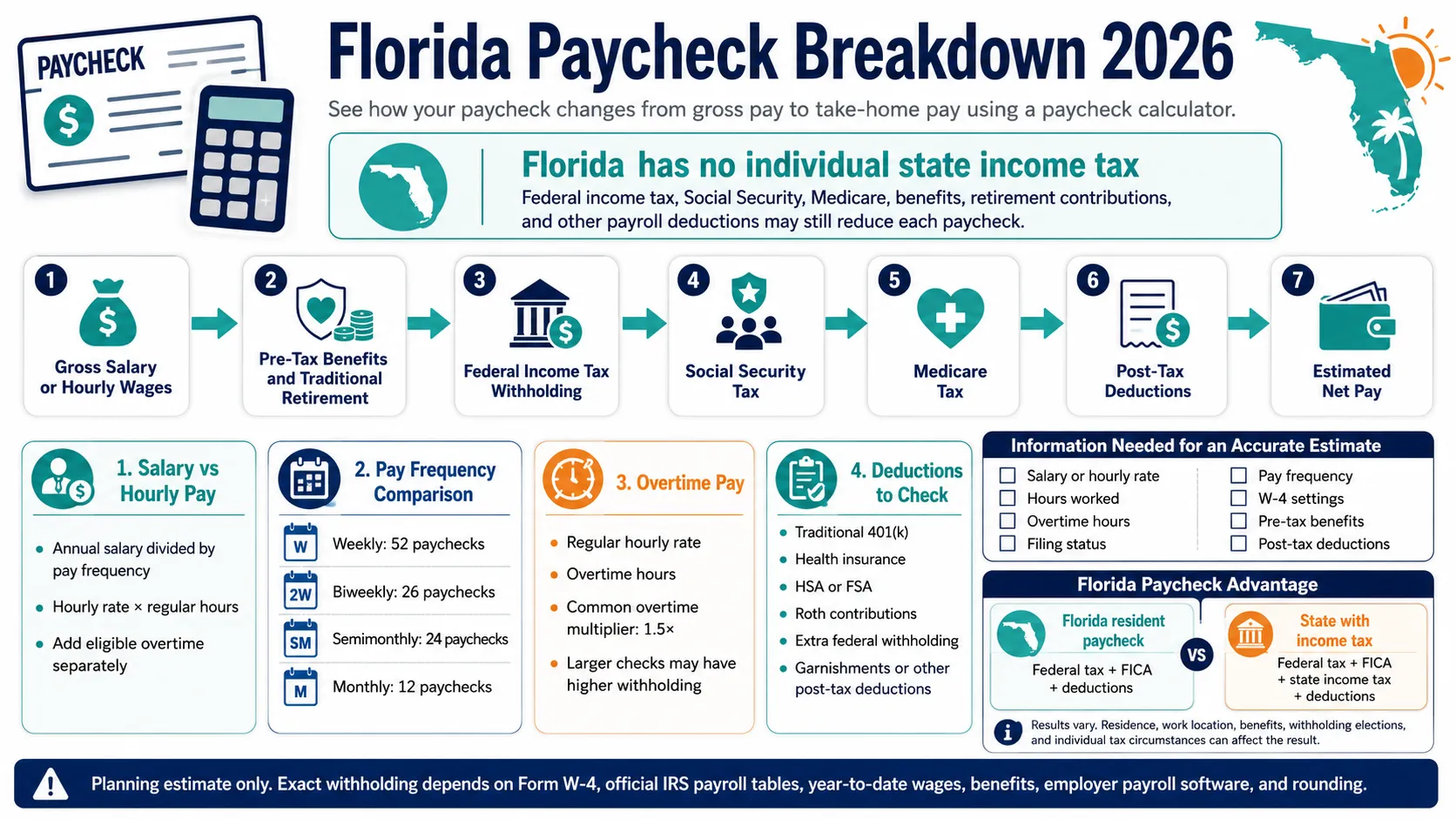
Florida does not impose personal income tax on employee wages. A normal Florida paycheck can still include federal income-tax withholding, Social Security, Medicare, retirement contributions, benefit premiums, extra federal withholding, garnishments, and other post-tax deductions.
Workers who live or perform services in another state may also see that state’s withholding. That is a multi-state payroll issue, not Florida personal income tax.
Florida Net Pay and Withholding Calculator
Enter the details that actually change payroll. The result updates automatically and remains an estimate rather than an official payroll calculation.
What the Calculator Result Means
| Result | How to use it | Common mistake to avoid |
|---|---|---|
| Per-paycheck take-home | Compare with the net-pay line on a check using the same pay frequency. | Comparing a biweekly estimate with a semimonthly check. |
| Monthly take-home | Use annual estimated net divided by 12 for budgeting. | Multiplying one biweekly check by two; two months usually have a third biweekly payday. |
| Total reduction | See the combined effect of taxes, benefits, retirement, and deductions. | Calling the entire reduction a “tax rate.” |
| Other-state withholding | Model a known non-Florida withholding amount. | Labeling it Florida personal income tax. |
Florida Job Offer and Monthly Budget Check
A salary can look attractive before health coverage, housing, auto insurance, transportation, debt, and savings are included. Enter the costs that will continue every month.
How the 2026 Form W-4 Changes a Florida Paycheck
Florida has no personal income-tax withholding form, so Form W-4 is the main employee form controlling income-tax withholding on a standard Florida paycheck. The 2026 form also includes a dedicated exemption checkbox.
When “exempt from withholding” is appropriate
The 2026 Form W-4 has an exemption checkbox. Selecting it tells the employer not to withhold federal income tax, but Social Security and Medicare generally still apply. Use it only when you satisfy the IRS conditions for no federal income-tax liability in the prior year and expect none in the current year.
For a pay-period-specific check, compare your entries with the official 2026 Form W-4 and instructions. For a household with multiple jobs, pensions, or uneven income, use the IRS Tax Withholding Estimator after understanding the fields above.
What IRS Publication 15-T Adds That a Simple Calculator Misses
Publication 15-T is the employer’s federal withholding guide. It translates Form W-4 information into wage-bracket or percentage-method withholding for a specific payroll period. That is why an employer portal can differ from an annual tax estimate.
| Payroll detail | How the employer uses it | What you should compare |
|---|---|---|
| Pay date and pay period | Selects the correct 2026 table and weekly, biweekly, semimonthly, monthly, or other-period method. | The pay frequency and period dates on the paystub. |
| Form W-4 version | Uses the current form or special adjustments for an older pre-2020 form still on file. | The W-4 actually stored in the payroll portal. |
| Step 2 multiple-job adjustment | Changes the withholding calculation when the checkbox or another method is used. | Whether both spouses or both job records were updated consistently. |
| Step 3 and Step 4 amounts | Applies annual credits, other income, deductions, and per-check extra withholding. | Dollar amounts, not assumptions about filing status alone. |
| Supplemental wages | May apply an aggregate or separate supplemental-wage method to bonus or commission pay. | Whether the payment was combined with regular wages or issued separately. |
Employers and payroll professionals should use the official 2026 Publication 15-T PDF for exact withholding procedures. This page intentionally labels its result as an estimate.
Qualified Tips and Overtime: What the 2026 W-4 Worksheet Actually Means
The 2026 W-4 deductions worksheet includes lines for qualified tips and qualified overtime compensation. These deductions affect estimated federal income-taxable income; they do not make the wages disappear from Social Security or Medicare wages.
Qualified tips
The worksheet allows an eligible estimated deduction of up to $25,000, subject to occupation, reporting, income, filing-status, and phaseout rules. Enter reported tips as wages in the calculator first. Enter only the verified deductible amount in Step 4(b).
Do not subtract the same tips twice, and do not assume every gratuity or service charge is a qualified tip.
Qualified overtime compensation
The worksheet describes a maximum deduction of $12,500, or $25,000 for married filing jointly, subject to eligibility and phaseout rules. For time-and-a-half pay, only the “and-a-half” premium portion is potentially relevant—not the employee’s entire overtime wage.
The calculator displays an estimated premium for a 1.5× overtime setup but does not automatically claim it as a deduction. For tax years 2026 and later, employers and other payers are required to separately report qualified overtime compensation on updated information returns.
Read the worksheet and limits in the official 2026 Form W-4 PDF before entering a Step 4(b) amount.
Florida Minimum Wage in 2026: The Pay Date Matters
Florida’s minimum wage changes during calendar year 2026. The calculator uses the selected date as a screening proxy. If a pay period crosses September 30, compare the hours with the rate in effect when the work was performed, not only the paycheck date.
| Effective period | Standard minimum wage | Tipped direct cash wage | How to use it |
|---|---|---|---|
| January 1–September 29, 2026 | $14.00 per hour | $10.98 per hour | Compare hours worked in this period with the earlier 2026 rate. |
| Beginning September 30, 2026 | $15.00 per hour | $11.98 per hour | Use the higher rate for work covered on and after the effective date. |
A tipped direct wage does not replace the employer’s obligation to ensure total cash wages plus eligible tips meet the full applicable minimum wage. Overtime, exemptions, tip-credit rules, recordkeeping, and local facts can require a more detailed review.
Check the current poster and notices through the Florida Department of Commerce required-posters page. For federal overtime rules, use the U.S. Department of Labor overtime guidance.
Florida Has No Personal Income Tax—but Employer Payroll Taxes Still Exist
Florida’s lack of personal income tax means the calculator does not subtract a Florida employee income-tax line. It does not mean the employer has no state payroll obligations.
| Item | Who normally pays it? | Should it reduce employee net pay here? |
|---|---|---|
| Florida personal income tax | Not imposed on individuals | No; estimated at $0. |
| Federal income-tax withholding | Employee through payroll withholding | Yes, based on the W-4 estimate. |
| Employee Social Security and Medicare | Employee share withheld; employer also pays a share | Yes, employee share is estimated. |
| Florida reemployment tax | Employer | No. Florida’s employer guide says workers do not pay it and employers must not deduct it from payroll. |
| Other-state income tax | Employee when another state’s rules apply | Only when a known multi-state amount is entered. |
Florida employers can review registration, wage-base, reporting, and rate information through the Florida Department of Revenue reemployment-tax page and its official employer guide. Employees should ask payroll to identify any unfamiliar Florida-labeled deduction rather than assuming it is personal income tax.
Pre-Tax and Post-Tax Deductions That Change Take-Home Pay
A useful paycheck estimate must classify deductions by tax treatment. Entering every deduction as “pre-tax” can make the result look artificially high.
| Deduction or limit | Common paycheck treatment | 2026 planning detail |
|---|---|---|
| Traditional 401(k), 403(b) or TSP | Often reduces federal income-taxable wages but generally not Social Security or Medicare wages. | Employee elective-deferral limit is $24,500 before applicable catch-up rules. |
| Roth retirement contribution | Generally post-tax for current federal income-tax purposes. | Enter it as post-tax, not in the traditional-retirement percentage. |
| Health FSA | Can reduce taxable wages through an eligible cafeteria plan. | Employee contribution limit is $3,400; qualifying carryover can be up to $680. |
| HSA | Payroll contributions through an eligible arrangement can receive favorable income-tax and FICA treatment. | Contribution limits are $4,400 self-only and $8,750 family before applicable catch-up amounts. |
| Qualified commuter or parking benefit | May reduce taxable wages within applicable limits. | Monthly exclusion limit is $340 for qualified transportation and $340 for qualified parking. |
| Health, dental and vision premium | Often pre-tax when offered through an eligible employer plan. | Use the paystub’s federal, Social Security, and Medicare wage boxes to confirm treatment. |
| Union dues, garnishment or after-tax insurance | Often deducted after taxes. | Enter the actual per-check amount in post-tax deductions. |
Contribution limits do not prove that a deduction is available or eligible. Review the employer plan and the IRS 2026 retirement-limit announcement before maximizing payroll elections.
Biweekly vs semimonthly pay
Biweekly payroll normally produces 26 checks per year. Semimonthly payroll normally produces 24. A semimonthly check is usually larger for the same annual salary, while a biweekly worker normally has two three-paycheck months.
Biweekly: 26 checks Semimonthly: 24 checksHourly vs salary pay
Hourly workers should enter regular wages, overtime, tips, and unpaid weeks separately. Salaried workers should enter annual base salary and add expected bonus or commission wages. Neither pay type determines whether a worker is exempt from overtime law.
Florida Salary After-Tax Examples
These examples use a single filer, biweekly payroll, no Step 2 adjustment, no credits, no benefits, no retirement, and no extra withholding. They are starting points, not promises of an exact check.
| Annual salary | Estimated biweekly net | Estimated monthly net | Best next check |
|---|---|---|---|
| $40,000 | $0 | $0 | Housing, insurance, transport, and benefit deductions. |
| $50,000 | $0 | $0 | Form W-4, healthcare premium, debt, and savings. |
| $75,000 | $0 | $0 | Retirement percentage and monthly fixed costs. |
| $100,000 | $0 | $0 | Multiple jobs, bonus pay, and extra withholding. |
| $150,000 | $0 | $0 | Social Security wage base, Medicare, and retirement limits. |
Florida Residents, Remote Work and Multi-State Withholding
When to use the other-state withholding field
Use it only when a paystub, payroll estimate, or tax professional gives you a known per-check amount. Do not guess another state’s tax from a flat percentage, because resident credits, reciprocity, sourcing, and local taxes can change the result.
Why Your Paystub May Not Match This Calculator
- The pay frequency, pay date, or number of paid workweeks is wrong.
- The paycheck includes overtime, tips, bonus, commission, retro pay, reimbursement, severance, or a partial period.
- The employer has a different Form W-4 filing status, Step 2 choice, credits, deductions, or extra withholding on file.
- A traditional retirement contribution was entered as Roth, or a Roth contribution was treated as pre-tax.
- A health, HSA, FSA, or commuter deduction changes different taxable wage boxes than assumed.
- The employer uses exact Publication 15-T tables and year-to-date wage data rather than annualized estimates.
- Social Security withholding stopped or changed after cumulative wages reached the annual wage base.
- Another state’s withholding applies because of physical work location or residency.
- An unfamiliar deduction is employer insurance, garnishment, union dues, or another payroll item—not Florida income tax.
How to reconcile the result with a real paystub
Official Sources Used for This 2026 Calculator
Each source is placed after the explanation it supports so users can confirm a detail without being sent away before understanding the issue.
Florida Paycheck Calculator FAQs
Does Florida have state income tax on paychecks?
No. Florida does not impose personal income tax, so this calculator uses $0 for Florida employee income-tax withholding. Federal tax, Social Security, Medicare, benefits, and other deductions can still reduce take-home pay.
What taxes normally come out of a Florida paycheck?
A standard Florida W-2 paycheck can include federal income-tax withholding, employee Social Security, employee Medicare, and any applicable Additional Medicare withholding. Another state’s withholding can apply in a multi-state situation.
How much is a $50,000 salary after taxes in Florida?
The exact amount depends on pay frequency, Form W-4 settings, credits, benefits, retirement, and other deductions. Use the $50,000 preset for a personalized estimate rather than relying on one fixed number.
How do I calculate a biweekly Florida paycheck?
Select biweekly pay, which normally means 26 checks per year. Do not use semimonthly, which normally means 24 checks and produces a different per-check amount.
Is overtime taxed at a separate permanent rate?
No. Overtime remains wage income. A larger check can have higher withholding because of payroll annualization or supplemental-wage methods, but final federal income tax is based on annual taxable income and applicable deductions.
What changed on the 2026 Form W-4?
The 2026 form includes an exemption checkbox and a deductions worksheet covering qualified tips, qualified overtime compensation, vehicle-loan interest, and other deductions. Steps 2, 3, and 4 still materially affect withholding.
Can I deduct all overtime pay on Form W-4?
No. The qualified overtime rule is limited and can apply only to the eligible premium portion, subject to dollar limits, phaseouts, filing rules, and other requirements. Do not enter total overtime wages as a deduction.
How are tips handled in this calculator?
Enter reported cash tips as wages so they are included in gross income and FICA. Enter a separate Step 4(b) deduction only when you have verified an eligible qualified-tip amount under the 2026 rules.
What is Florida’s minimum wage in 2026?
It is $14.00 per hour through September 29, 2026 and $15.00 beginning September 30, 2026. The tipped direct cash wage is $10.98 and then $11.98 on the same dates, subject to tip-credit requirements.
Does Florida reemployment tax come out of employee pay?
No. Florida reemployment tax is an employer-paid tax. The state’s employer guide says workers do not pay it and employers must not deduct it from payroll.
Does a traditional 401(k) reduce Social Security and Medicare tax?
Generally no. A traditional contribution commonly reduces federal income-taxable wages but does not reduce Social Security or Medicare wages. Eligible benefit deductions may have different treatment.
Why does ADP or my employer portal show another amount?
The employer system knows the exact stored W-4, pay date, year-to-date wages, benefit tax treatment, special earnings, official withholding method, and rounding. This tool uses annual planning estimates.
What if I live in Florida but work in another state?
The work state may tax wages earned there even though Florida has no personal income tax. Review physical work location, residence, reciprocity, remote-work rules, and employer payroll coding.
Can I use this calculator to evaluate a Florida job offer?
Yes. Use the job-offer tool to compare estimated monthly take-home with housing, utilities, transport, insurance, healthcare, food, debt, savings, and other recurring costs.
Is this an exact payroll calculation or tax advice?
No. It is a planning estimate. Exact withholding requires official IRS tables, the employee’s actual Form W-4, year-to-date payroll data, benefit treatment, and employer payroll calculations.
Related Paycheck Planning
Return to the Paycheck Calculators homepage to choose another location or pay scenario. No internal article links are included here unless they can be confirmed from the site’s live post sitemap.
Recalculate Before You Accept the Offer or Change Payroll Elections
Run the estimate again when pay date, salary, hourly rate, overtime, tips, Form W-4, benefits, retirement, work state, housing, insurance, or monthly costs change.
Calculate Again