
Free South Dakota Paycheck Calculator 2026
Estimate your South Dakota take-home pay from annual salary or hourly wages after federal income tax, Social Security, Medicare, retirement, health benefits, overtime, extra federal withholding, and other payroll deductions.
Quick Answer: How South Dakota Take-Home Pay Works
South Dakota does not impose an individual state income tax, so a normal South Dakota paycheck does not include South Dakota income-tax withholding. Employees can still have federal income tax, Social Security, Medicare, retirement contributions, health insurance, HSA or FSA deductions, garnishments, union dues, and other payroll items.
South Dakota’s Reemployment Assistance program is financed through employer payroll taxes. Workers do not contribute to that program through an employee paycheck deduction. An unfamiliar state unemployment line on a paystub should therefore be checked with payroll rather than automatically entered in this calculator.
South Dakota Paycheck Breakdown at a Glance
This visual guide shows how salary or hourly gross income moves through federal income tax, Social Security, Medicare, retirement, benefits, overtime, and other deductions before becoming estimated take-home pay.
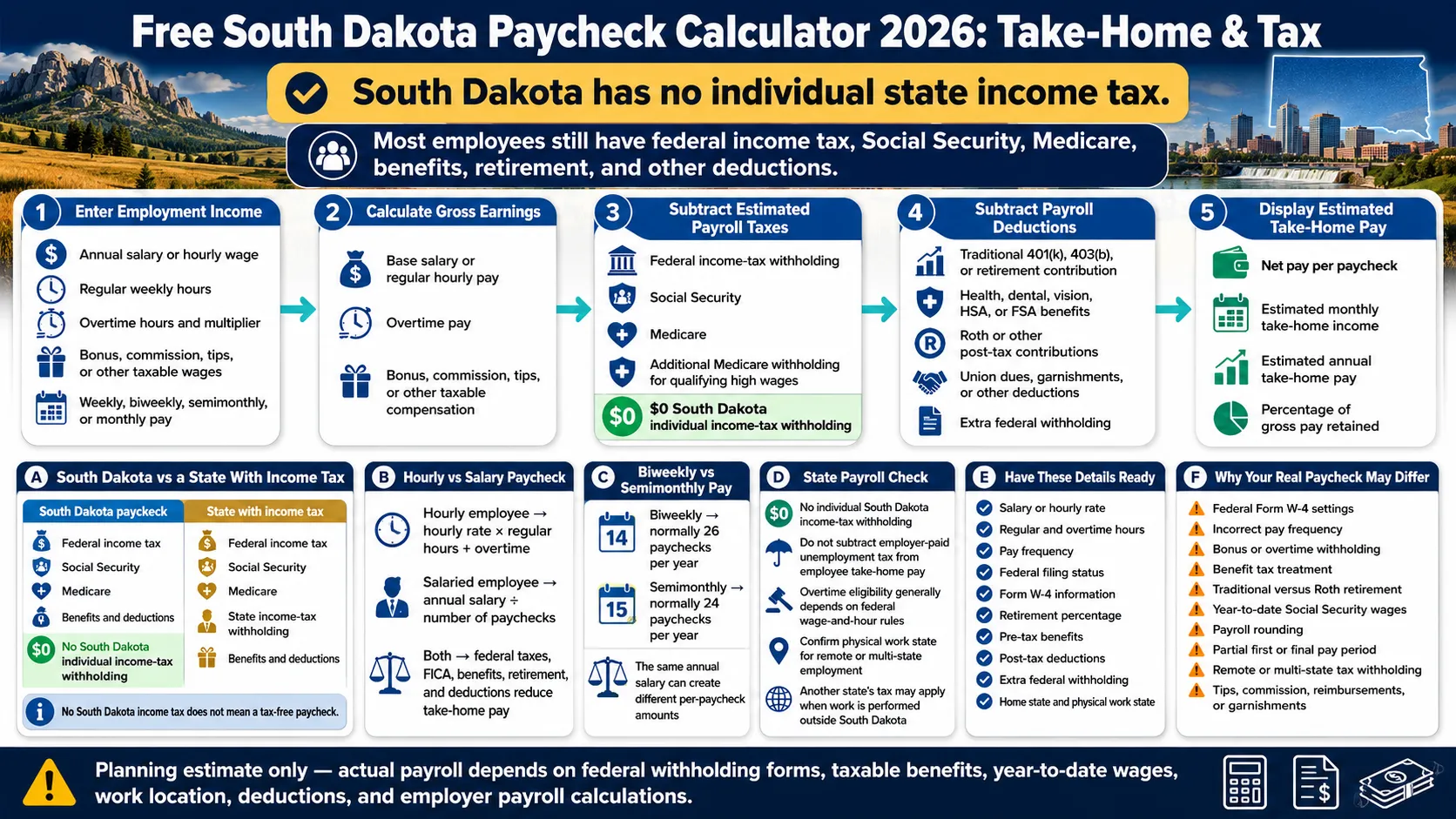
South Dakota Paycheck Calculator With Taxes and Deductions
Enter the payroll details that match your job. Results include salary or hourly pay, overtime, bonus income, federal tax, FICA, retirement, benefits, extra withholding, other deductions, and a monthly budget estimate.
What “No South Dakota State Income Tax” Actually Means
South Dakota does not deduct an individual state income tax from normal employee wages. This can make take-home pay higher than an otherwise similar job in a state with wage-based income-tax withholding, but it does not make the entire paycheck tax-free.
| Paycheck item | Typical employee deduction | Important explanation |
|---|---|---|
| South Dakota individual income tax | $0 | South Dakota does not impose an individual state income tax. |
| South Dakota Reemployment Assistance tax | $0 | The program is financed through employer payroll taxes; workers do not contribute. |
| Federal income tax | Varies | Depends on Form W-4, pay, filing status, credits, deductions, and payroll tables. |
| Social Security | 6.2% up to the annual wage base | The 2026 Social Security taxable wage base is $184,500. |
| Medicare | 1.45%, plus 0.9% withholding above $200,000 | Regular Medicare does not use the Social Security wage cap. |
| Benefits and retirement | Varies | Health plans, retirement, HSA/FSA, Roth contributions, and other items can reduce take-home pay. |
Monthly South Dakota Budget From Your Paycheck
Gross salary does not show whether income can cover housing, fuel, vehicle costs, winter utilities, insurance, food, debt, childcare, medical costs, and savings. This snapshot converts the estimated annual net pay into a monthly planning figure.
South Dakota Job Offer and Housing Affordability Calculator
Use this tool before accepting a job in Sioux Falls, Rapid City, Aberdeen, Brookings, Watertown, Pierre, or another South Dakota community. It compares estimated monthly take-home income with recurring expenses.
Common South Dakota Paycheck Searches Explained
How This South Dakota Paycheck Estimate Works
| Paycheck component | Calculation approach | Why a paystub may differ |
|---|---|---|
| Federal income tax | Uses 2026 federal tax brackets, standard deductions, entered credits and an optional additional deduction. | Employers use Publication 15-T, the exact W-4, pay-period methods and official rounding. |
| Social Security | Uses 6.2% of applicable wages up to the 2026 taxable wage base. | Year-to-date wages determine when the annual wage cap is reached. |
| Medicare | Uses 1.45%, plus 0.9% employee withholding above $200,000. | The payroll threshold can differ from final Additional Medicare Tax liability. |
| South Dakota income tax | Always shows $0 because South Dakota has no individual income tax. | Another state’s tax may appear when services are performed outside South Dakota. |
| Reemployment Assistance tax | Shows $0 as an employee deduction. | The South Dakota program is financed through employer payroll taxes. |
| Benefits and deductions | Separates traditional retirement, pre-tax benefits, post-tax deductions and extra withholding. | Each employer plan can affect federal and FICA wage bases differently. |
Which Deductions Reduce Which Taxes?
| Deduction | Common payroll treatment | How to enter it |
|---|---|---|
| Traditional 401(k) or 403(b) | Often reduces federal income-taxable wages but generally does not reduce Social Security or Medicare wages. | Use the traditional retirement percentage field. |
| Roth retirement contribution | Usually deducted after federal income tax. | Use the post-tax deduction field. |
| Health, dental or vision insurance | Often pre-tax through an eligible employer plan, but treatment varies. | Use pre-tax benefits and verify whether it reduces FICA wages. |
| HSA or FSA contribution | Can be pre-tax when made through an eligible payroll arrangement. | Include it in pre-tax benefits after confirming plan treatment. |
| Union dues or garnishment | Often deducted after federal and FICA taxes. | Use the post-tax or other payroll-deduction field. |
| Extra federal withholding | Reduces current take-home as an additional federal tax payment. | Use the dedicated extra federal withholding field. |
South Dakota Overtime Pay and the 2026 Federal Deduction
South Dakota does not have a separate state overtime law. Federal Fair Labor Standards Act rules generally determine overtime eligibility for covered nonexempt workers. Many qualifying employees receive time-and-a-half after more than 40 hours in a workweek, but exemptions and special industry rules can apply.
How overtime affects the paycheck
Overtime increases gross wages and is generally still subject to federal income-tax withholding, Social Security and Medicare. A larger overtime check may show more withholding because payroll annualizes the larger payment.
Enter regular and overtime hours separately so the calculator can apply the selected pay multiplier before estimating taxes and deductions.
What “no tax on overtime” means
For tax years 2025 through 2028, eligible individuals may claim a federal deduction for the qualified overtime premium—the portion above the regular rate that is required by the FLSA. It does not automatically make the complete overtime payment tax-free on each paycheck.
The annual deduction is generally limited to $12,500, or $25,000 for married couples filing jointly, and begins phasing out above the applicable income limits. This calculator does not automatically reduce payroll withholding for that potential tax-return deduction.
2026 Numbers Used in This South Dakota Paycheck Calculator
| 2026 item | Amount or rule | How the calculator uses it |
|---|---|---|
| Federal standard deduction | $16,100 single, $32,200 joint and $24,150 head of household | Reduces estimated federal taxable income. |
| Federal marginal rates | 10%, 12%, 22%, 24%, 32%, 35% and 37% | Applied progressively to estimated federal taxable income. |
| Social Security employee rate | 6.2% | Applied to eligible wages up to the annual wage base. |
| Social Security wage base | $184,500 | Caps wages subject to the employee Social Security estimate. |
| Medicare | 1.45%, plus 0.9% withholding above $200,000 | Applied to estimated Medicare wages. |
| South Dakota individual income tax | None | No South Dakota state income-tax amount is subtracted. |
| Employee Reemployment Assistance contribution | $0 | The employer-funded program is not deducted from employee take-home pay. |
2026 vs 2025 South Dakota Paycheck Calculations
South Dakota’s no-individual-income-tax treatment remains the same, but federal deductions, federal tax brackets, the Social Security wage base and overtime-reporting rules changed for 2026.
| Item | 2025 reference | 2026 input | Why it matters |
|---|---|---|---|
| Federal standard deduction — single | $15,750 | $16,100 | Using an older amount can overstate federal taxable income. |
| Federal standard deduction — joint | $31,500 | $32,200 | Joint estimates should use the correct wage year. |
| Social Security wage base | $176,100 | $184,500 | Higher earners can pay Social Security tax on more wages in 2026. |
| Qualified overtime reporting | Transitional reporting rules | Separate employer or payer reporting required | Employees may need the separately reported amount for the federal overtime deduction. |
| South Dakota income tax | $0 | $0 | Federal and payroll deductions remain the main tax-related paycheck reductions. |
Biweekly vs Semimonthly Pay
Biweekly payroll normally produces 26 paychecks per year. Semimonthly payroll normally produces 24. The same annual salary can therefore create a larger semimonthly paycheck because the salary is divided by fewer checks.
Biweekly: 26 checks Semimonthly: 24 checksHourly vs Salary Paycheck
Hourly employees should enter their rate, regular hours, overtime hours, multiplier and paid weeks. Salaried employees should enter annual salary and add bonuses, commission, tips or other taxable wages separately.
Hourly: rate × hours Salary: annual compensationSouth Dakota Salary After Tax Examples
These dynamic examples assume a single filer, biweekly pay, no retirement, no benefit deductions, no extra withholding and no other payroll deductions. They include federal income tax, Social Security and Medicare but no South Dakota income tax.
| Common salary search | Estimated biweekly take-home | Estimated monthly take-home | What to check next |
|---|---|---|---|
| $40,000 salary after taxes in South Dakota | $0 | $0 | Health insurance, vehicle costs, rent and W-4 settings. |
| $50,000 salary after taxes in South Dakota | $0 | $0 | Retirement percentage, benefits and monthly debt. |
| $75,000 salary after taxes in South Dakota | $0 | $0 | Housing, commuting, savings and insurance costs. |
| $100,000 salary after taxes in South Dakota | $0 | $0 | W-4 credits, bonuses, extra withholding and retirement. |
| $150,000 salary after taxes in South Dakota | $0 | $0 | Social Security wage base, Medicare and benefit limits. |
South Dakota Resident, Nonresident and Remote-Work Notes
Why Your Real South Dakota Paycheck May Not Match
- The wrong weekly, biweekly, semimonthly or monthly pay frequency was selected.
- Your federal Form W-4 filing status, credits, deductions or extra withholding differs.
- Traditional retirement was entered as Roth, or Roth was treated as pre-tax.
- A health, HSA, FSA or insurance deduction affects different taxable wage boxes.
- The paycheck includes overtime, bonus, commission, tips, back pay or severance.
- The first or final paycheck covers only part of a normal pay period.
- Payroll uses exact pay dates, Publication 15-T tables and year-to-date wages.
- Social Security withholding changed after annual wages reached the wage base.
- Another state’s income tax is being withheld because of physical work location.
- A reimbursement, garnishment, union due or benefit deduction was entered incorrectly.
- Multiple jobs caused the combined federal withholding estimate to differ.
- Payroll rounding produces small differences between a public estimate and the paystub.
How to Match the Calculator With Your Real Paystub
Official Source Notes
This is an independent planning calculator and is not an official South Dakota or federal government payroll tool. Employers should use current official payroll publications and their payroll system for compliance.
South Dakota Paycheck Calculator FAQs
How much is my paycheck after taxes in South Dakota?
Enter your salary or hourly wage, pay frequency, federal filing status, overtime, retirement, benefits, extra withholding and other deductions. The calculator estimates take-home pay per paycheck, per month and per year.
Does South Dakota have a state income tax?
No. South Dakota does not impose an individual state income tax, so normal employee wages do not have South Dakota income-tax withholding.
Is a South Dakota paycheck tax-free?
No. Federal income tax, Social Security, Medicare, benefits, retirement contributions and other deductions can still reduce take-home pay.
Do South Dakota employees pay state unemployment tax?
No. South Dakota’s Reemployment Assistance program is financed through employer payroll taxes, and workers do not contribute through an employee paycheck deduction.
Can I calculate hourly pay and overtime in South Dakota?
Yes. Select hourly pay and enter the hourly rate, regular weekly hours, overtime hours, pay multiplier and paid workweeks.
Does South Dakota require overtime after 40 hours?
South Dakota does not have a separate state overtime law. Federal Fair Labor Standards Act rules generally govern overtime for covered nonexempt employees.
Is overtime completely tax-free in 2026?
No. Overtime compensation generally remains subject to payroll withholding, Social Security and Medicare. Eligible workers may claim a federal deduction for the qualified overtime premium, subject to annual limits and income phaseouts.
What is the difference between biweekly and semimonthly pay?
Biweekly payroll normally produces 26 paychecks per year. Semimonthly payroll normally produces 24, so the same annual salary can create different per-paycheck amounts.
Does a traditional 401(k) reduce South Dakota paycheck taxes?
A traditional retirement contribution commonly reduces federal income-taxable wages but generally does not reduce Social Security or Medicare wages. South Dakota has no individual income tax to reduce.
Why does ADP or my employer payroll portal show a different result?
An employer payroll system uses the exact Form W-4, pay-period tables, taxable benefits, year-to-date wages, pay dates, supplemental earnings and payroll rounding. This calculator uses annual planning estimates.
Can another state’s tax appear on a South Dakota resident’s paycheck?
Yes. Another state may require withholding when the employee physically performs services there or has another connection covered by that state’s rules.
Should I use a 2025 or 2026 South Dakota paycheck calculator?
Use the year in which wages are paid because federal brackets, standard deductions, the Social Security wage base and payroll reporting rules can change.
Can I use this calculator before accepting a South Dakota job?
Yes. The job-offer tool compares estimated monthly take-home pay with housing, utilities, transport, food, debt, benefits, savings and other recurring costs.
Can this calculator replace official payroll tables or tax advice?
No. It is a planning estimate and cannot replace IRS Publication 15-T, employer payroll software, tax preparation, legal advice or professional payroll guidance.
Estimate Your South Dakota Take-Home Pay Before Payday
Recalculate whenever salary, hourly rate, overtime, pay frequency, Form W-4 settings, retirement, benefits, home or work location, housing, debt or monthly expenses change.
Run the South Dakota Calculator Again