
Free Rhode Island Paycheck Calculator 2026
Estimate your Rhode Island take-home pay from annual salary or hourly wages after federal income tax, Social Security, Medicare, Rhode Island withholding, the employee-funded TDI/TCI contribution, retirement, benefits, overtime, extra withholding, and post-tax deductions.
Quick Answer: How Rhode Island Take-Home Pay Works
A Rhode Island paycheck starts with gross salary, regular hourly earnings, overtime, bonus, commission, tips, or other taxable wages. Payroll can then subtract federal income tax, Social Security, Medicare, Rhode Island income-tax withholding, the combined Temporary Disability Insurance and Temporary Caregiver Insurance employee contribution, benefit premiums, retirement contributions, extra withholding, and other deductions.
Rhode Island uses three progressive withholding rates. For 2026, the annual percentage schedule applies 3.75% to the first bracket, 4.75% to the middle bracket, and 5.99% above the highest threshold. Rhode Island also requires its own RI W-4; the federal W-4 should not be used as a replacement for state withholding setup.
Rhode Island Paycheck Breakdown at a Glance
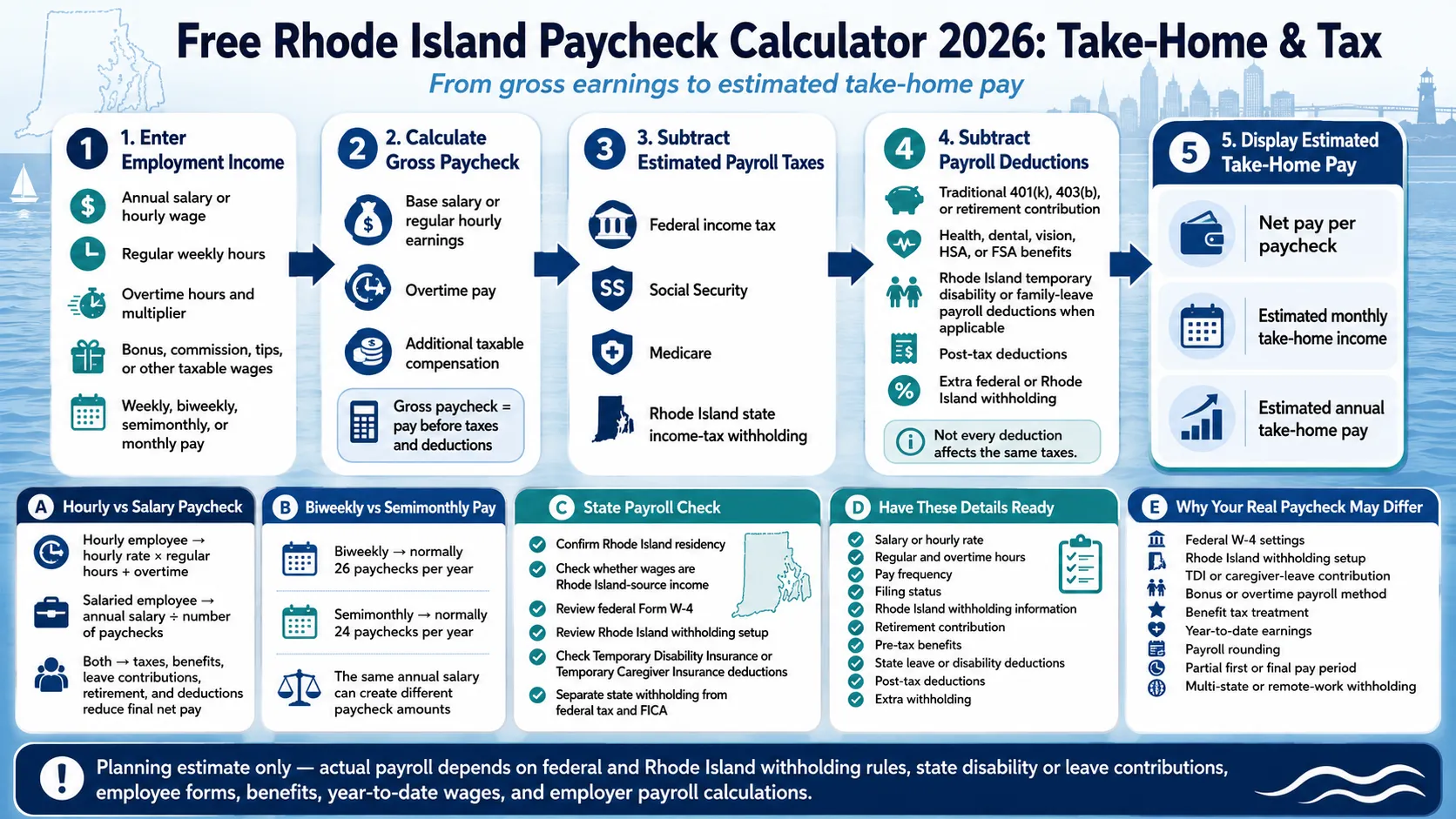
This infographic shows how salary or hourly gross income moves through federal tax, Social Security, Medicare, Rhode Island withholding, TDI/TCI, benefits, retirement, overtime, and other deductions before becoming estimated take-home pay.
Rhode Island Paycheck Calculator With Taxes and TDI/TCI
Enter the details that match your payroll. The tool supports salary, hourly wages, overtime, bonuses, weekly or biweekly pay, RI W-4 exemptions, TDI/TCI, retirement, benefits, extra withholding, post-tax deductions, and monthly budget planning.
Rhode Island Tax Impact: With vs Without State Withholding
This comparison isolates the Rhode Island income-tax withholding estimate. It can help when reviewing a military-spouse exemption, work performed outside Rhode Island, a move between states, or a paycheck that does not match expectations.
| Scenario | Estimated paycheck | Estimated monthly take-home | Practical meaning |
|---|---|---|---|
| With Rhode Island withholding | $0 | $0 | Use for wages subject to regular Rhode Island withholding. |
| Without Rhode Island withholding | $0 | $0 | Use only for a valid exemption or planning comparison. |
| Estimated state-tax difference | $0 | $0 | This isolates RI withholding and does not calculate another state’s tax. |
Rhode Island TDI/TCI Paycheck Impact
Rhode Island Temporary Disability Insurance and Temporary Caregiver Insurance are funded through the employee TDI payroll contribution. For 2026, the employee rate is 1.1% of covered wages up to the $100,000 taxable wage base, creating a maximum annual employee contribution of $1,100.
| TDI/TCI scenario | Estimated paycheck | Estimated annual contribution | Planning use |
|---|---|---|---|
| Include employee TDI/TCI contribution | $0 | $0 | Use when the deduction appears on a covered Rhode Island paystub. |
| Exclude TDI/TCI contribution | $0 | $0 | Use only when employment is not subject to this employee deduction. |
| Estimated paycheck difference | $0 | Based on entered wages | This deduction is separate from RI income tax, Social Security, and Medicare. |
Monthly Rhode Island Budget From Your Paycheck
Gross salary does not show whether an offer can support rent, utilities, transportation, insurance, food, debt, childcare, medical costs, and savings. This snapshot converts estimated annual take-home pay into a monthly planning figure.
Rhode Island Job Offer and Housing Affordability Calculator
Use this tool before accepting a job in Providence, Warwick, Cranston, Newport, Pawtucket, Woonsocket, or another Rhode Island community. It compares estimated monthly net pay with your recurring costs.
Common Rhode Island Paycheck Searches Explained
How This Rhode Island Paycheck Estimate Works
| Paycheck component | Calculation approach | Why a paystub can differ |
|---|---|---|
| Federal income tax | Uses 2026 federal brackets, standard deductions, entered W-4 credits, and an optional additional deduction. | Employers use Publication 15-T, the exact W-4, pay-period methods, and official rounding. |
| Social Security | Uses 6.2% of applicable wages up to the 2026 wage base. | Year-to-date wages determine when the annual taxable maximum is reached. |
| Medicare | Uses 1.45%, plus 0.9% employee withholding above $200,000. | The payroll threshold can differ from final joint-return liability. |
| Rhode Island withholding | Uses the 2026 3.75%, 4.75%, and 5.99% annual percentage schedule and entered RI W-4 exemptions. | The actual RI W-4, exemption phaseout, wage-bracket table, and pay period matter. |
| TDI/TCI | Uses 1.1% of covered wages up to $100,000 when enabled. | Coverage, age, year-to-date covered wages, and multiple-employer situations can affect the line. |
| Benefits and other deductions | Separates retirement, pre-tax benefits, post-tax items, and extra withholding. | Each employer plan can affect federal, RI, FICA, all, or none of those wage bases. |
Which Forms and Records Control a Rhode Island Paycheck?
| Form or record | What it controls | When to review it |
|---|---|---|
| Federal Form W-4 | Federal income-tax withholding | New job, marriage, dependents, second job, or a major income change |
| Rhode Island Form RI W-4 | State withholding exemptions, additional withholding, and eligible exemption claims | Starting work, changing exemptions, or correcting state withholding |
| Military-spouse exemption section | Possible exemption under the Military Spouses Residency Relief Act | When a qualifying spouse moved to Rhode Island solely to accompany a servicemember |
| Payroll home and work locations | Resident-state and source-state payroll setup | Moving, remote work, hybrid work, or changing assigned work locations |
| W-2 wage and withholding boxes | Year-end federal, Social Security, Medicare, and Rhode Island reporting | When taxable wage boxes differ from gross compensation |
| TDI/TCI paystub line | Employee contribution toward Rhode Island disability and caregiver insurance | When the deduction reaches the wage-base limit or appears incorrect |
Which Deductions Reduce Which Taxes?
| Deduction | Common treatment | How to enter it |
|---|---|---|
| Traditional 401(k) or 403(b) | Often reduces federal and Rhode Island income-taxable wages but generally not Social Security or Medicare wages. | Use the traditional retirement percentage field. |
| Roth retirement contribution | Usually deducted after income taxes. | Use the post-tax deduction field. |
| Health, dental or vision insurance | Often pre-tax through an eligible employer plan, but treatment varies. | Use pre-tax benefits and confirm whether the plan reduces FICA wages. |
| HSA or FSA contribution | Can be pre-tax when made through an eligible payroll arrangement. | Include the amount in pre-tax benefits after verifying payroll treatment. |
| Rhode Island TDI/TCI | Separate employee payroll contribution based on covered wages. | Use the dedicated TDI/TCI option rather than the post-tax field. |
| Union dues or garnishment | Often deducted after taxes. | Use the post-tax or other payroll-deduction field. |
2026 Numbers Used in This Rhode Island Paycheck Calculator
| 2026 item | Amount or rule | How the calculator uses it |
|---|---|---|
| Federal standard deduction | $16,100 single, $32,200 joint, and $24,150 head of household | Reduces estimated federal taxable income. |
| Social Security wage base | $184,500 | Caps wages subject to the 6.2% employee Social Security estimate. |
| Medicare | 1.45%, plus 0.9% withholding above $200,000 | Applied to estimated Medicare wages. |
| First Rhode Island bracket | 3.75% through $82,050 | Applied progressively to estimated Rhode Island taxable wages. |
| Middle Rhode Island bracket | 4.75% from $82,050 through $186,450 | Applied only to wages within the middle bracket. |
| Top Rhode Island bracket | 5.99% above $186,450 | Applied to the portion above the highest threshold. |
| RI W-4 exemption amount | $1,000 per entered exemption in the withholding formula | Reduces annualized wages unless the wage phaseout is triggered. |
| TDI/TCI contribution | 1.1% on the first $100,000 of covered wages | Creates a maximum estimated annual employee contribution of $1,100. |
2026 vs 2025 Rhode Island Paycheck Calculations
Use the year in which wages are paid. Even when the Rhode Island marginal percentages remain the same, inflation-adjusted state thresholds, federal deductions, federal brackets, the Social Security wage base, and the Rhode Island TDI rate or wage base can change.
| Item | 2025 reference | 2026 input | Paycheck effect |
|---|---|---|---|
| Federal standard deduction — single | $15,750 | $16,100 | Using the older amount can overstate federal taxable income. |
| Social Security wage base | $176,100 | $184,500 | Higher earners can pay Social Security tax on more wages. |
| RI TDI rate | 1.3% | 1.1% | The percentage declined for 2026. |
| RI TDI taxable wage base | $89,200 | $100,000 | The lower percentage applies to a larger maximum amount of covered wages. |
| RI income-tax thresholds | Previous inflation-adjusted thresholds | $82,050 and $186,450 | The current annual withholding table should be used for 2026 pay dates. |
Biweekly vs Semimonthly Pay
Biweekly payroll normally produces 26 paychecks per year. Semimonthly payroll normally produces 24. The annual salary can be the same while the semimonthly check is larger because salary is divided by fewer checks.
Biweekly: 26 checks Semimonthly: 24 checksHourly vs Salary Paycheck
Hourly employees should enter rate, regular hours, overtime hours, multiplier, and paid workweeks. Salaried employees should enter annual salary and add expected bonuses, commission, tips, or other wages separately.
Hourly: rate × hours Salary: annual compensationRhode Island Salary After Tax Examples
These examples assume a single filer, one RI W-4 exemption, normal Rhode Island withholding, the 2026 TDI/TCI deduction, biweekly pay, and no retirement, benefits, extra withholding, or other deductions.
| Common salary search | Estimated biweekly take-home | Estimated monthly take-home | What to check next |
|---|---|---|---|
| $40,000 salary after taxes in Rhode Island | $0 | $0 | Insurance, RI W-4, TDI, rent, and transportation. |
| $50,000 salary after taxes in Rhode Island | $0 | $0 | Retirement, benefits, housing, and monthly debt. |
| $75,000 salary after taxes in Rhode Island | $0 | $0 | Tolls, parking, rent, savings, and health costs. |
| $100,000 salary after taxes in Rhode Island | $0 | $0 | W-4 credits, TDI wage base, benefits, and bonus pay. |
| $150,000 salary after taxes in Rhode Island | $0 | $0 | Social Security wage base, Medicare, retirement limits, and exemption phaseout. |
Rhode Island Resident, Nonresident and Remote-Work Notes
Why Your Real Rhode Island Paycheck May Not Match
- The wrong weekly, biweekly, semimonthly, or monthly frequency was selected.
- Your RI W-4 exemptions or additional withholding differ from the entered values.
- Your wages exceed the Rhode Island exemption phaseout level.
- The TDI/TCI deduction is disabled even though it appears on the paystub.
- Year-to-date TDI wages have already reached the annual taxable wage base.
- Your federal W-4 credits, deductions, multiple-job setting, or extra withholding differ.
- Traditional retirement was entered as Roth, or Roth was treated as pre-tax.
- A health, HSA, FSA, or insurance deduction affects different wage boxes.
- The check includes overtime, bonus, commission, tips, retro pay, severance, or reimbursement.
- Payroll uses exact wage-bracket tables, pay dates, year-to-date wages, and rounding.
- Social Security withholding changed after reaching the annual wage base.
- The first or final paycheck covers only part of the normal pay period.
How to Match the Calculator With Your Paystub
Official Source Notes
This is an independent planning calculator, not an official Rhode Island government payroll tool. Employers and payroll professionals should use official federal and Rhode Island publications for compliance.
Rhode Island Paycheck Calculator FAQs
How much is my paycheck after taxes in Rhode Island?
Enter your salary or hourly wage, pay frequency, federal filing status, RI W-4 exemptions, overtime, TDI/TCI status, retirement, benefits, and other deductions. The calculator estimates take-home pay per paycheck, per month, and per year.
What are the Rhode Island income-tax rates for 2026?
Rhode Island’s 2026 annual percentage schedule uses 3.75% through $82,050, 4.75% from $82,050 through $186,450, and 5.99% above $186,450.
What is the Rhode Island TDI/TCI deduction in 2026?
The 2026 employee contribution is 1.1% of covered wages up to the $100,000 taxable wage base, creating a maximum annual employee contribution of $1,100.
Are TDI and TCI separate paycheck deductions?
Temporary Caregiver Insurance is financed through the Rhode Island TDI employee contribution, so workers generally see the TDI payroll contribution rather than two separate percentage deductions.
Can I calculate hourly pay and overtime in Rhode Island?
Yes. Select hourly pay and enter the hourly rate, regular weekly hours, overtime hours, multiplier, and paid workweeks. The calculator adds overtime before estimating taxes and deductions.
What is the difference between biweekly and semimonthly pay?
Biweekly payroll normally produces 26 paychecks per year. Semimonthly payroll normally produces 24. The same annual salary can therefore create different per-paycheck amounts.
Does Rhode Island require its own W-4?
Yes. Rhode Island requires Form RI W-4 for state withholding purposes. The federal Form W-4 should not be used as a replacement for the Rhode Island certificate.
Do nonresidents pay Rhode Island tax on wages?
A nonresident employee can be subject to Rhode Island withholding on wages paid for services performed in Rhode Island. Residence outside the state does not automatically remove Rhode Island withholding.
Does a traditional 401(k) reduce Rhode Island paycheck taxes?
A traditional retirement contribution commonly reduces federal and Rhode Island income-taxable wages, but it generally does not reduce Social Security or Medicare wages.
Why does ADP or my employer payroll portal show a different result?
An employer payroll system uses the exact W-4, RI W-4, pay-period table, benefits, TDI wage history, year-to-date wages, pay date, supplemental earnings, and rounding. This calculator uses annual planning estimates.
Should I use a 2025 or 2026 Rhode Island paycheck calculator?
Use the year in which wages are paid. Federal deductions, Rhode Island thresholds, the Social Security wage base, and the Rhode Island TDI rate or wage base can change between years.
Can this calculator replace official payroll tables or tax advice?
No. It is a planning estimate and cannot replace IRS Publication 15-T, Rhode Island withholding tables, employer payroll software, tax preparation, legal advice, or professional payroll guidance.
Related Paycheck Calculators
Browse the calculator directory for additional state, hourly, salary, overtime, and take-home-pay tools.
Estimate Your Rhode Island Take-Home Pay Before Payday
Recalculate whenever salary, hourly rate, overtime, pay frequency, RI W-4 exemptions, TDI coverage, retirement, benefits, home or work location, housing, or monthly expenses change.
Run the Rhode Island Calculator Again