
Oregon Paycheck Calculator 2026
Estimate Oregon take-home pay from annual salary or hourly wages after federal income tax, Social Security, Medicare, Oregon withholding, Statewide Transit Tax, Paid Leave Oregon, Workers’ Benefit Fund, benefits, overtime and other payroll deductions.
Quick Answer: How Oregon Take-Home Pay Works
An Oregon paycheck can subtract federal income tax, Social Security, Medicare, Oregon income-tax withholding, the Statewide Transit Tax, Paid Leave Oregon employee contributions, the employee share of the Workers’ Benefit Fund assessment, retirement contributions, benefit premiums, extra withholding and post-tax deductions.
Oregon uses its own Form OR-W-4 and a state-specific withholding formula. The state calculation can depend on Oregon filing status, allowances, a limited federal-tax subtraction, a payroll standard deduction and the employee’s wage level.
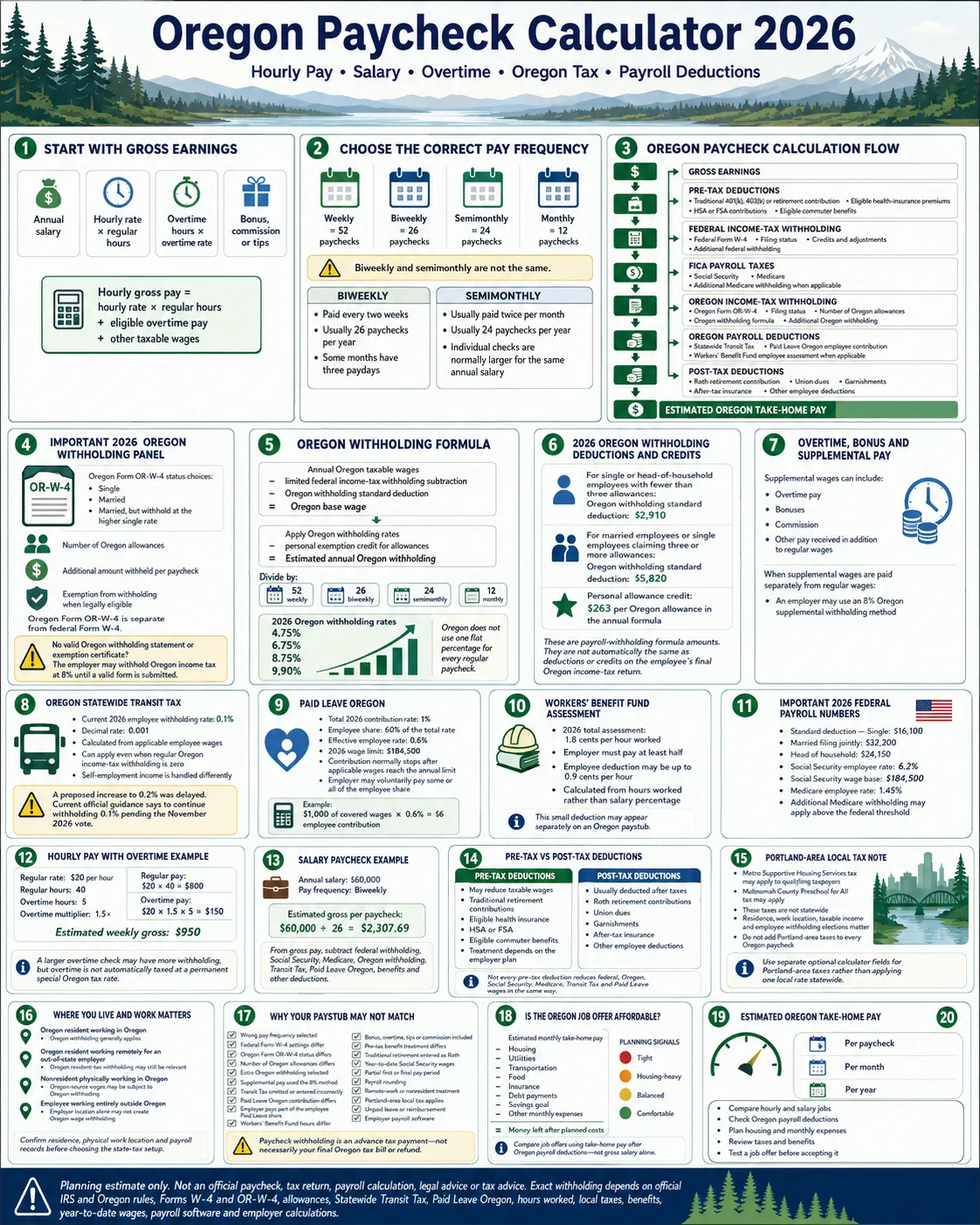
Oregon Paycheck Calculator With Taxes and Deductions
Enter your actual pay arrangement. The result updates automatically and can also be refreshed with the calculate button.
Oregon Payroll Impact: With vs Without Oregon-Specific Items
This comparison isolates Oregon income-tax withholding, the Statewide Transit Tax, Paid Leave Oregon and the Workers’ Benefit Fund. It is useful for moving, remote-work and cross-state job comparisons, but it does not determine final filing liability.
| Scenario | Estimated paycheck | Estimated monthly take-home | Practical meaning |
|---|---|---|---|
| With Oregon income tax and payroll items | $0 | $0 | Uses Oregon withholding, transit tax, Paid Leave, WBF and entered local withholding. |
| Without Oregon-specific items | $0 | $0 | Comparison only; another state or local tax may still apply. |
| Estimated Oregon difference | $0 | $0 | Approximate effect of Oregon-specific payroll lines selected in the tool. |
Monthly Oregon Budget From Your Paycheck
Gross salary does not show whether a job can support housing, debt, bills, commuting and savings. This snapshot converts annual net pay into a monthly planning number.
Oregon Job Offer and Rent Affordability Calculator
Test whether a salary offer can cover recurring monthly costs after estimated federal taxes, FICA, Oregon withholding, Paid Leave, transit tax, retirement and benefits.
What Common Oregon Paycheck Searches Actually Mean
These phrases describe different payroll problems. Each needs a specific field, comparison or explanation rather than a keyword mention.
How This Oregon Paycheck Estimate Works
| Paycheck component | Calculation approach | Why a real paystub may differ |
|---|---|---|
| Federal income tax | 2026 annual brackets, standard deduction, entered W-4 credits and optional federal-only deduction. | Employers use Publication 15-T, exact W-4 fields, pay-period methods and rounding. |
| Social Security | 6.2% of estimated Social Security wages up to the 2026 annual wage base. | Year-to-date wages determine when the wage base is reached. |
| Medicare | 1.45% of Medicare wages plus 0.9% employee withholding above $200,000. | The withholding threshold may differ from final joint-return liability. |
| Oregon income tax | 2026 withholding formula using OR-W-4 status, allowances, limited federal-tax subtraction and payroll deduction amounts. | Official wage tables, exact pay-period wages, high-income phase-outs and employer settings matter. |
| Statewide Transit Tax | 0.1% of estimated applicable Oregon wages when selected. | Residence, work location, wage definition and exemption details can matter. |
| Paid Leave Oregon | Entered employee rate, normally 0.6%, up to the 2026 wage limit. | An employer may pay some or all of the employee share. |
| Workers’ Benefit Fund | Employee share estimated at 0.9 cents per hour worked. | Actual hours and employer-paid share determine the line. |
| Portland-area local withholding | Manual verified amount entered by the user. | Metro and Multnomah taxes depend on jurisdiction, income, filing status and withholding election. |
Federal W-4 vs Oregon OR-W-4: Which Form Controls What?
| Form or record | What it controls | When to review it |
|---|---|---|
| Federal Form W-4 | Federal income-tax withholding | New job, marriage, dependents, second job, major income change or repeated balance due. |
| Oregon Form OR-W-4 | Oregon status, allowances, exemption and extra state withholding | Starting a job, changing family situation, moving, or when Oregon withholding is consistently high or low. |
| Employer payroll residence and work location | State and local jurisdiction coding | Moving into or out of Oregon, changing remote-work location, or working partly in Oregon. |
| Portland-area withholding election | Payroll withholding for Metro SHS or Multnomah PFA when required or elected | Higher income, employer notice, moving into the jurisdiction or changing work location. |
| Paystub taxable-wage lines | Shows which benefits reduce federal, FICA or Oregon wages | When gross pay matches but tax calculations do not. |
2026 Oregon Payroll Numbers Used in This Calculator
| 2026 item | Amount or rule | How the tool uses it |
|---|---|---|
| Federal standard deduction | $16,100 single, $32,200 married filing jointly, $24,150 head of household | Reduces estimated federal taxable income. |
| Social Security wage base | $184,500 | Caps wages subject to the 6.2% employee Social Security estimate. |
| Oregon payroll standard deduction | $2,910 for single/head with fewer than three allowances; $5,820 for married or single with three or more allowances | Subtracted in the 2026 Oregon withholding formula. |
| Oregon allowance credit | $263 per allowance in the annual withholding formula | Subtracted after applying the Oregon rate formula, subject to high-income limits. |
| Federal-tax subtraction in Oregon formula | Up to $8,750, with high-income phase-outs | Limits the estimated federal withholding subtracted from Oregon wages. |
| Oregon withholding rates | 4.75%, 6.75%, 8.75% and 9.9% | Applied through the official annualized formula structure. |
| Statewide Transit Tax | 0.1%, decimal 0.001 | Applied to estimated applicable Oregon wages when selected. |
| Paid Leave Oregon | 1% total contribution; employee share normally 0.6%; wage limit $184,500 | Uses the employee-rate field and wage limit. |
| Workers’ Benefit Fund | 1.8 cents total per hour; employer pays at least half | Defaults the employee estimate to 0.9 cents per hour. |
Oregon Statewide Transit Tax, Paid Leave and WBF Explained
Statewide Transit Tax
The 2026 rate remains 0.1%. It can apply even when regular Oregon income-tax withholding is zero. It is an employee wage tax and is not the same as employer-paid TriMet or Lane transit payroll taxes.
Paid Leave Oregon
The total 2026 contribution rate is 1% of covered wages up to $184,500. Employees normally pay 60% of that rate, or 0.6%, but an employer may pay some or all of the employee portion.
Workers’ Benefit Fund
The total 2026 assessment is 1.8 cents per hour worked. Employers must pay at least half, so the employee share is commonly no more than 0.9 cents per hour.
Why three separate lines?
Oregon income tax, transit tax, Paid Leave and WBF use different bases and rules. Treating them as one flat “Oregon tax” can hide why the real paystub differs.
Oregon Overtime, Bonuses, Commission and Tips
Hourly gross pay equals regular wages plus eligible overtime and other taxable wages. Use the hourly fields to model regular and overtime hours, then add annual bonus, commission or tips.
Hourly overtime example
At $20 per hour, 40 regular hours create $800 of regular weekly pay. Five overtime hours at 1.5× create $150 more, producing $950 of estimated weekly gross pay.
Separate supplemental payment
Oregon permits an 8% withholding method for certain separately paid supplemental wages. That withholding percentage is an advance payment and is not necessarily the final Oregon tax rate on the earnings.
Portland, Metro and Multnomah County Paycheck Taxes
Oregon does not impose one statewide city wage-tax rate. Some higher-income workers in the Portland area may have Metro Supportive Housing Services or Multnomah County Preschool for All tax withheld. The correct result depends on jurisdiction, filing status, taxable income, employer withholding requirements and employee elections.
| Local tax | 2026 planning information | How to use this calculator |
|---|---|---|
| Metro Supportive Housing Services | 1% above the 2026 Metro taxable-income threshold: $128,000 single or $205,000 joint-status threshold. | Enter the verified payroll withholding amount in the manual local field. |
| Multnomah County Preschool for All | 1.5% above the applicable first threshold and an additional 1.5% above the higher threshold under current published guidance. | Use the actual employer withholding amount instead of applying it statewide. |
| Other Oregon locations | Do not automatically add Metro or Multnomah personal income tax. | Leave the local field at zero unless a verified local withholding applies. |
Oregon Resident, Nonresident, Remote Work and Moving Notes
Why Your Real Oregon Paycheck May Not Match
- Weekly, biweekly, semimonthly or monthly pay frequency was selected incorrectly.
- Federal Form W-4 settings differ from the calculator inputs.
- Oregon Form OR-W-4 status, allowances, exemption or extra withholding differs.
- Employer payroll uses the official wage-bracket table rather than this annualized estimate.
- Paid Leave Oregon is paid partly or fully by the employer.
- Statewide Transit Tax is included or excluded because of residence, work location or wage rules.
- WBF hours differ because of overtime, partial weeks, leave or salary payroll assumptions.
- Metro SHS or Multnomah PFA withholding appears on the paystub.
- Traditional retirement was entered as Roth, or a post-tax item was entered as pre-tax.
- Health, HSA, FSA or commuter benefits reduce different taxable-wage boxes.
- The check includes bonus, commission, tips, retro pay, reimbursement or severance.
- Separately paid supplemental wages used the 8% Oregon method.
- Social Security withholding changed after cumulative wages reached the annual wage base.
- The first or final paycheck covers only part of a pay period.
- Employer payroll uses exact dates, year-to-date wages, cents and rounding.
How to Match This Estimate With Your Real Paystub
Official Source Notes
This independent calculator summarizes official information for planning. Employers should use official publications and payroll systems for compliance.
Oregon Paycheck Calculator FAQs
How much is my paycheck after taxes in Oregon?
Enter salary or hourly wages, pay frequency, federal filing status, OR-W-4 status, allowances, overtime, benefits, retirement, Oregon payroll items and extra withholding. The calculator estimates take-home pay per paycheck, month and year.
Does Oregon have state income tax?
Yes. Oregon uses progressive income-tax rates and a detailed payroll-withholding formula. The paycheck estimate depends on wages, OR-W-4 status, allowances, a limited federal-tax subtraction and Oregon payroll deduction amounts.
What is the Oregon Statewide Transit Tax?
It is an employee wage tax currently withheld at 0.1%, or decimal 0.001, from applicable wages. It is separate from Oregon income-tax withholding and from employer-paid TriMet or Lane transit payroll taxes.
What is Paid Leave Oregon on my paycheck?
Paid Leave Oregon is a family and medical leave program funded by employer and employee contributions. For 2026 the total rate is 1%, employees normally pay 0.6%, and covered wages are limited to $184,500.
What is Oregon WBF on a paycheck?
WBF means Workers’ Benefit Fund. The total 2026 assessment is 1.8 cents per hour worked, and employers must pay at least half. This calculator defaults the employee share to 0.9 cents per hour.
How do I calculate hourly pay and overtime in Oregon?
Select hourly pay and enter the hourly rate, regular weekly hours, overtime hours, overtime multiplier and paid workweeks. The calculator adds regular wages, overtime and other annual wages before estimating taxes and deductions.
What is the difference between biweekly and semimonthly pay?
Biweekly pay normally means 26 checks per year. Semimonthly pay normally means 24 checks. The annual salary can be the same while each individual paycheck differs.
Does a traditional 401(k) reduce Oregon paycheck taxes?
A traditional pre-tax retirement contribution can reduce federal and Oregon income-taxable wages, but it generally does not reduce Social Security or Medicare wages. Actual treatment depends on the plan.
Why does ADP or my payroll portal show a different Oregon paycheck?
Employer payroll can use exact W-4 and OR-W-4 records, official wage tables, year-to-date wages, benefit codes, work location, local-tax settings, supplemental-pay methods and rounding. This public tool uses annual planning estimates.
Does Oregon have local income tax on wages?
Oregon does not apply one city wage-tax rate statewide. Some higher-income workers may have Metro Supportive Housing Services or Multnomah County Preschool for All tax withheld. Jurisdiction, taxable income, filing status and payroll election matter.
What if I work remotely in Oregon?
Residence and physical work location both matter. Oregon residents working for an out-of-state employer and nonresidents working physically in Oregon may need Oregon withholding, while work performed entirely outside Oregon can be treated differently.
Should I use a 2025 or 2026 Oregon paycheck calculator?
Use the calculator for the year the wages are paid. Federal brackets, Social Security limits, Oregon formula amounts, Paid Leave wage limits and Workers’ Benefit Fund rates can change each year.
Can I use this calculator before accepting an Oregon job offer?
Yes. Use the job-offer tool to compare estimated monthly take-home pay with housing, utilities, food, transport, debt, benefits, savings, local withholding and other recurring costs.
Is this Oregon paycheck calculator legal or tax advice?
No. It is a planning estimate. For exact payroll, withholding, filing, Paid Leave, WBF, local-tax or compliance decisions, consult official publications or a qualified payroll or tax professional.
Can this calculator replace official Oregon payroll tables?
No. Employers should use official IRS and Oregon withholding tables, current employee forms, payroll software and agency guidance for compliance.
Estimate Your Oregon Take-Home Pay Before Payday
Recalculate whenever salary, hourly schedule, overtime, residence, W-4, OR-W-4 allowances, benefits, retirement, Paid Leave contribution, local withholding, housing or monthly costs change. Use the result before accepting a job, signing a lease or updating deductions.
Run the Oregon Calculator Again