
Ohio Paycheck Calculator 2026
Estimate Ohio take-home pay from annual salary or hourly wages after federal income tax, Social Security, Medicare, Ohio income tax, municipal tax, school district tax, retirement, benefits, overtime, extra withholding, and post-tax deductions.
Quick Answer: How Ohio Take-Home Pay Works
An Ohio paycheck normally begins with gross wages and subtracts federal income-tax withholding, Social Security, Medicare, Ohio income-tax withholding, local municipal tax when applicable, school district income tax when the employee lives in a taxing district, retirement, benefits, extra withholding, and post-tax deductions.
Ohio local tax is the part most generic calculators miss. Work-city tax, a possible resident-city balance after credit, JEDD or JEDZ tax, and residence-based school district tax can produce different take-home pay for two employees earning the same salary.
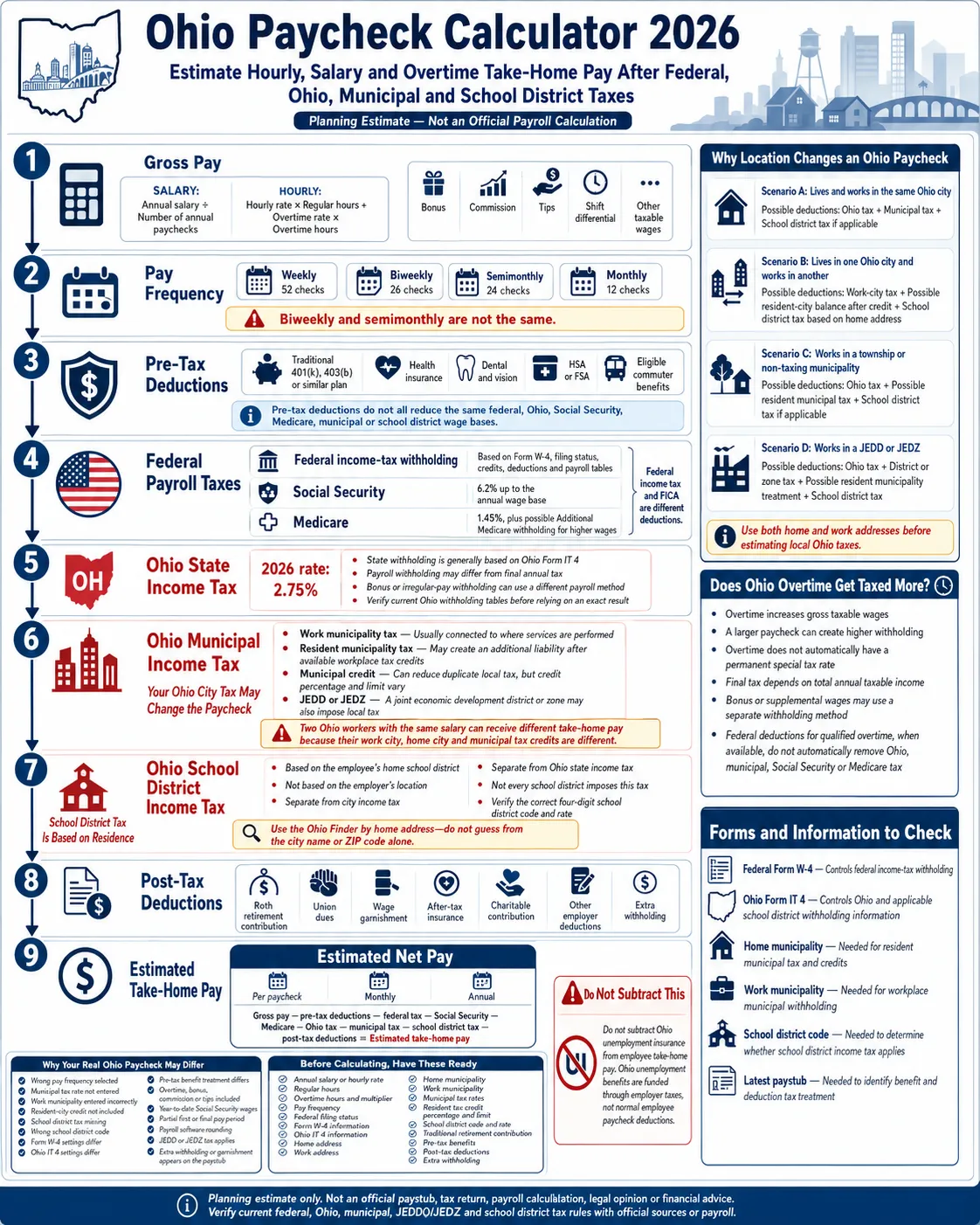
Ohio Paycheck Calculator With Taxes and Deductions
Enter your real pay arrangement and local-tax information. Results update automatically and can also be refreshed with the calculate button.
Ohio Local Tax Impact: Municipal, School District, and JEDD/JEDZ
This comparison isolates the local-tax effect from the selected work municipality, resident municipality, school district, and JEDD or JEDZ fields. It does not replace an address lookup or the resident municipality’s official credit rules.
| Scenario | Estimated paycheck | Estimated monthly take-home | Practical meaning |
|---|---|---|---|
| With selected Ohio local taxes | $0 | $0 | Includes work municipal, resident balance, school district, and JEDD/JEDZ estimates. |
| Without local income-tax estimates | $0 | $0 | Keeps federal, FICA, Ohio state tax, benefits, and other deductions. |
| Estimated local-tax difference | $0 | $0 | Shows why the same salary can produce different take-home pay across Ohio locations. |
Monthly Ohio Budget From Your Paycheck
Gross salary alone does not show whether a job can support housing, transportation, debt, utilities, savings, insurance, and daily costs. This snapshot converts the estimated annual net amount into a monthly planning number.
Ohio Job Offer and Rent Affordability Calculator
Use this second tool to test a job offer after estimated taxes, benefits, local tax, housing, commuting, debt, savings, and recurring costs.
Common Ohio Paycheck Searches Explained
These searches describe different payroll problems. Each one needs a practical calculation or explanation rather than a repeated keyword.
How This Ohio Paycheck Estimate Works
The calculator annualizes regular wages, overtime, and other earnings. It then estimates federal taxable income, FICA wages, Ohio taxable income, local taxable wages, taxes, deductions, and extra withholding before dividing the result by the selected pay frequency.
| Paycheck component | Calculation approach | Why the paystub may differ |
|---|---|---|
| Federal income tax | Estimated with 2026 brackets, standard deduction, entered credits, and optional federal-only deduction. | Employers use Publication 15-T, Form W-4 details, pay-period methods, and rounding. |
| Social Security | 6.2% of estimated Social Security wages up to the 2026 annual wage base. | Year-to-date wages and benefit treatment determine when the wage base is reached. |
| Medicare | 1.45% of Medicare wages plus a 0.9% employee withholding estimate above $200,000. | Employer withholding and final joint-return liability can differ. |
| Ohio income tax | Planning estimate using the 2026 statutory formula above the $26,050 threshold. | Ohio IT 4 settings and official withholding tables calculate actual payroll withholding. |
| Municipal income tax | Work-city tax plus an estimated resident-city balance after entered credit rules. | Cities set their own rates, credit factors, credit limits, exemptions, and administrators. |
| School district tax | Entered residence-based rate applied to estimated wage income. | District type, rate, residence dates, and taxable-income rules affect actual liability. |
| JEDD or JEDZ tax | Entered rate applied separately to estimated local taxable wages. | Address boundaries and credit treatment require confirmation with the taxing authority. |
Information to Check Before Calculating an Ohio Paycheck
| Information | Where to find it | Why it changes the result |
|---|---|---|
| Gross salary or hourly rate | Offer letter, employment agreement, paystub, or payroll portal | It is the starting point for gross-to-net calculations. |
| Pay frequency | Payroll calendar or recent paystub | Weekly, biweekly, semimonthly, and monthly schedules divide annual pay differently. |
| Federal Form W-4 | Employer payroll or HR portal | Filing status, credits, deductions, other income, and extra withholding affect federal tax. |
| Ohio Form IT 4 | Employer onboarding or payroll records | It supplies Ohio and school district withholding information. |
| Home address and school district | Ohio Finder, county auditor, or official district information | School district tax is based on residence, and resident municipal tax or credit may apply. |
| Work address | Employer worksite or assignment records | The work municipality or JEDD/JEDZ can determine local withholding. |
| Benefit tax treatment | Benefits guide and taxable-wage lines on the paystub | A deduction may reduce federal, Ohio, FICA, municipal, school, all, or none of those wage bases. |
Form W-4 vs Ohio IT 4: Which Form Controls What?
| Form or record | What it controls | When to review it |
|---|---|---|
| Federal Form W-4 | Federal income-tax withholding | New job, marriage, dependents, second job, major income change, or repeated refund/balance-due problem |
| Ohio Form IT 4 | Ohio employer withholding and school district information | Starting employment, moving, changing school district, or changing Ohio withholding instructions |
| Home address | Resident municipality and residence-based school district | Moving, changing ZIP+4, or receiving an incorrect local or school tax line |
| Work location | Workplace municipal or JEDD/JEDZ withholding | Remote work, hybrid assignments, transfers, or multi-location work |
| W-2 wage boxes | Year-end federal, FICA, Ohio, municipal, and school district wage reporting | When taxable wage boxes do not match gross compensation |
Which Deductions Reduce Which Ohio Paycheck Taxes?
“With deductions” should not mean subtracting one combined number. A deduction’s tax treatment determines whether it affects federal, Ohio, FICA, municipal, or school district wages.
| Deduction | Common payroll treatment | Practical action |
|---|---|---|
| Traditional 401(k) or 403(b) | Often reduces federal and Ohio income-taxable wages but generally not Social Security, Medicare, or Ohio municipal wages. | Compare federal, state, Social Security, Medicare, and local wage boxes on the paystub. |
| Roth retirement contribution | Usually post-tax for income-tax purposes. | Enter it as post-tax rather than traditional retirement. |
| Health, dental, or vision insurance | Often pre-tax through an eligible plan, but treatment can vary. | Check whether the deduction reduces federal, Ohio, FICA, municipal, and school wages. |
| HSA or FSA | Often pre-tax when contributed through a qualifying payroll arrangement. | Verify eligibility, annual limits, and FICA treatment. |
| Union dues or garnishment | Often deducted after taxes. | Enter the actual per-paycheck amount as post-tax. |
| Extra withholding | Reduces current take-home pay but is not a benefit expense. | Enter federal and Ohio extra withholding in their separate fields. |
| Ohio unemployment insurance | Funded through employer unemployment taxes rather than a normal employee deduction. | Do not subtract it from employee take-home pay unless the paystub line is actually another item. |
Ohio Hourly Pay With Overtime, Bonuses, Tips, and Commission
Hourly paycheck with overtime
Enter regular weekly hours, overtime hours, the applicable multiplier, and paid workweeks. The calculator adds overtime to annual gross wages before estimating taxes.
Overtime is not automatically taxed at a permanent special rate. A larger paycheck can have higher withholding because payroll annualizes the pay period or treats part as supplemental wages.
Bonuses, commission, tips, and shift pay
Enter expected annual extra wages in the bonus, commission, tips, or other-wages field. The actual special-pay check can differ when the employer uses a supplemental or aggregate method.
Federal deductions for qualified tips or overtime, when available, do not automatically remove Ohio, municipal, school district, Social Security, or Medicare tax.
2026 Numbers Used in This Ohio Paycheck Calculator
| 2026 item | Amount or rule | How this calculator uses it |
|---|---|---|
| Federal standard deduction | $16,100 single, $32,200 married filing jointly, and $24,150 head of household | Reduces estimated federal taxable income. |
| Federal marginal tax rates | 10%, 12%, 22%, 24%, 32%, 35%, and 37% | Applied progressively to estimated annual federal taxable income. |
| Social Security wage base | $184,500 | Caps wages subject to the 6.2% employee Social Security estimate. |
| Medicare | 1.45%, plus 0.9% employee withholding above $200,000 | Applied to estimated Medicare wages without the Social Security wage cap. |
| Ohio individual income tax | $332 plus 2.75% of Ohio taxable income above $26,050 | Planning estimate when Ohio state tax is selected. |
| Ohio municipal tax | Varies by municipality, resident credit, JEDD/JEDZ, and work location | Uses user-entered local rates rather than a statewide assumption. |
| Ohio school district tax | Varies by residence and district; not every district imposes the tax | Uses the entered residence-based rate. |
Biweekly vs semimonthly pay in Ohio
Biweekly pay normally means 26 checks per year. Semimonthly pay normally means 24 checks per year. The annual salary can be identical, but a semimonthly check is usually larger because the salary is divided by fewer checks.
Biweekly: 26 checks Semimonthly: 24 checksHourly vs salary paycheck
Hourly workers should calculate regular and overtime wages separately. Salaried workers should enter annual base salary and add expected bonus or commission income. Both should include the correct local tax rates.
Hourly: rate × hours Salary: annual compensationOhio Salary After Tax Examples People Commonly Search
These dynamic examples use a single filer, biweekly pay, Ohio state tax, a 2.5% workplace municipal rate, no school district tax, and no retirement or benefit deductions. Your result can differ substantially by location and payroll settings.
| Common salary search | Estimated biweekly take-home | Estimated monthly take-home | What to check next |
|---|---|---|---|
| $40,000 salary after taxes in Ohio | $0 | $0 | Municipal rate, school district, insurance, commuting, and debt. |
| $60,000 salary after taxes in Ohio | $0 | $0 | Resident credit, retirement, housing, and savings. |
| $75,000 salary after taxes in Ohio | $0 | $0 | Work city, home city, IT 4, and benefit deductions. |
| $100,000 salary after taxes in Ohio | $0 | $0 | W-4 credits, bonus pay, school tax, and local credit limits. |
| $150,000 salary after taxes in Ohio | $0 | $0 | Social Security wage base, Medicare, bonus, and retirement limits. |
Why Location Changes an Ohio Paycheck
Why ADP or an Employer Payroll Portal May Show a Different Result
| Possible difference | Public planning calculator | Employer payroll system |
|---|---|---|
| W-4 details | Uses the filing status, credits, deductions, and extra withholding entered here. | Uses the W-4 currently stored in the employee profile. |
| Ohio IT 4 | Uses the optional Ohio adjustment and annual state-tax formula. | Uses exact IT 4 settings and official withholding tables. |
| Local jurisdiction | Uses entered municipal, credit, school, and JEDD/JEDZ rates. | Uses coded work and home tax jurisdictions or a local-tax provider. |
| Year-to-date wages | Models a full year from current inputs. | Knows previous checks, Social Security wages, and annual deduction totals. |
| Benefit setup | Uses the tax treatment selected by the user. | Knows the plan’s precise federal, Ohio, FICA, and local treatment. |
| Special pay | Annualizes bonus, tips, commission, and overtime for planning. | May use supplemental-wage, aggregate, retro-pay, or special payroll methods. |
Why Your Real Ohio Paycheck May Not Match
- Weekly, biweekly, semimonthly, or monthly pay frequency was selected incorrectly.
- The work municipality rate, resident municipality rate, credit factor, or credit limit is wrong.
- A JEDD or JEDZ tax applies but was not entered.
- The school district code or residence-based rate is missing or incorrect.
- Your federal W-4 filing status, Step 2 election, credits, deductions, or extra withholding differ.
- Your Ohio IT 4 instructions or payroll jurisdiction coding differ.
- Traditional retirement was entered as Roth, or a Roth deduction was entered as pre-tax.
- A health, HSA, FSA, or commuter deduction reduces different taxable wage boxes than expected.
- The paycheck includes overtime, bonus, commission, tips, shift pay, retroactive pay, severance, or reimbursement.
- Payroll software uses year-to-date wages and official withholding tables for the actual pay date.
- Social Security withholding changed after annual wages reached the wage base.
- The first or final check covers only part of a pay period.
- Ohio unemployment insurance was incorrectly assumed to be an employee deduction.
How to Match This Estimate With Your Real Paystub
Official Source Notes
This independent calculator summarizes official information for planning. Employers should use official payroll publications and local tax authorities for compliance.
Ohio Paycheck Calculator FAQs
How much is my paycheck after taxes in Ohio?
Enter salary or hourly wages, pay frequency, filing status, Ohio tax setting, municipal and school district rates, retirement, benefits, deductions, and extra withholding. The calculator estimates take-home pay per paycheck, per month, and per year.
What is the Ohio income-tax rate in 2026?
For taxable years beginning in 2026, Ohio law uses $332 plus 2.75% of taxable nonbusiness income above $26,050. Employer withholding can differ because payroll uses Ohio withholding tables and Form IT 4 information.
Does Ohio have local income tax?
Yes. Many Ohio cities and villages impose municipal income tax. The work municipality may withhold tax, and the resident municipality may impose an additional balance after its credit rules.
Is Ohio school district tax based on where I live or work?
Ohio school district income tax is based on where the employee lives, not where the employer is located. Not every school district imposes the tax, so verify the home address and district rate.
Can I calculate hourly pay and overtime in Ohio?
Yes. Select hourly pay and enter hourly rate, regular hours, overtime hours, overtime multiplier, and paid workweeks. The calculator adds overtime to annual gross wages before estimating taxes.
What is the difference between biweekly and semimonthly pay?
Biweekly pay usually means 26 paychecks per year. Semimonthly pay usually means 24 paychecks per year. The same annual salary produces a different paycheck amount under each schedule.
Does overtime get taxed more in Ohio?
Overtime increases taxable gross wages and can create higher withholding on a larger check, but it is not automatically subject to a permanent special tax rate. Final tax depends on total annual income and applicable federal, Ohio, and local rules.
Does a traditional 401(k) reduce Ohio paycheck taxes?
A traditional retirement contribution often reduces federal and Ohio income-taxable wages, but it generally does not reduce Social Security, Medicare, or Ohio municipal taxable wages. Check the wage boxes on the paystub.
Why is my real Ohio paycheck different from the calculator?
Differences can come from Form W-4, Ohio IT 4, local tax jurisdiction, resident credit rules, school district, JEDD/JEDZ, benefits, year-to-date wages, overtime, bonus pay, partial periods, and payroll rounding.
What does Ohio Form IT 4 control?
Ohio Form IT 4 provides withholding information to the employer and includes Ohio and school district details. Submit or update it according to employer and Ohio Department of Taxation instructions.
How does an Ohio resident municipal tax credit work?
A resident municipality may grant full, partial, or no credit for tax paid to another municipality. The credit factor and maximum creditable rate vary, so confirm the resident city’s official rules.
What are RITA and CCA in Ohio payroll taxes?
RITA and CCA administer municipal income tax for participating Ohio municipalities. A city may also administer its own tax, so the correct administrator depends on the municipality.
Does this Ohio calculator include bonuses and commission?
Yes. Enter expected annual bonus, commission, tips, shift pay, or other wages in the extra-income field. The actual special-pay check may use a different withholding method.
Can I use this calculator before accepting an Ohio job offer?
Yes. Use the job-offer tool to compare estimated monthly take-home pay with housing, utilities, transportation, food, debt, savings, benefits, and other recurring costs.
Can this calculator replace official payroll tables or tax advice?
No. It is a planning estimate and cannot replace IRS Publication 15-T, Ohio withholding tables, municipal or school district guidance, employer payroll software, tax preparation, legal advice, or professional payroll guidance.
Related Paycheck Calculators
Compare Ohio take-home pay with nearby state calculators when considering relocation, remote work, or a cross-border job.
Estimate Your Ohio Take-Home Pay Before Payday
Recalculate whenever salary, hourly schedule, overtime, home address, work location, school district, Form W-4, Ohio IT 4, retirement, benefits, rent, or monthly budget changes. Use the result before accepting a job, signing a lease, changing deductions, or comparing locations.
Run the Ohio Calculator Again