
Michigan Paycheck Calculator 2026
Estimate Michigan take-home pay from annual salary or hourly wages after federal withholding, FICA, Michigan income tax, optional Detroit or other city tax, benefits and payroll deductions.
2026 Michigan paycheck snapshot
Quick Answer: How a Michigan Paycheck Becomes Take-Home Pay
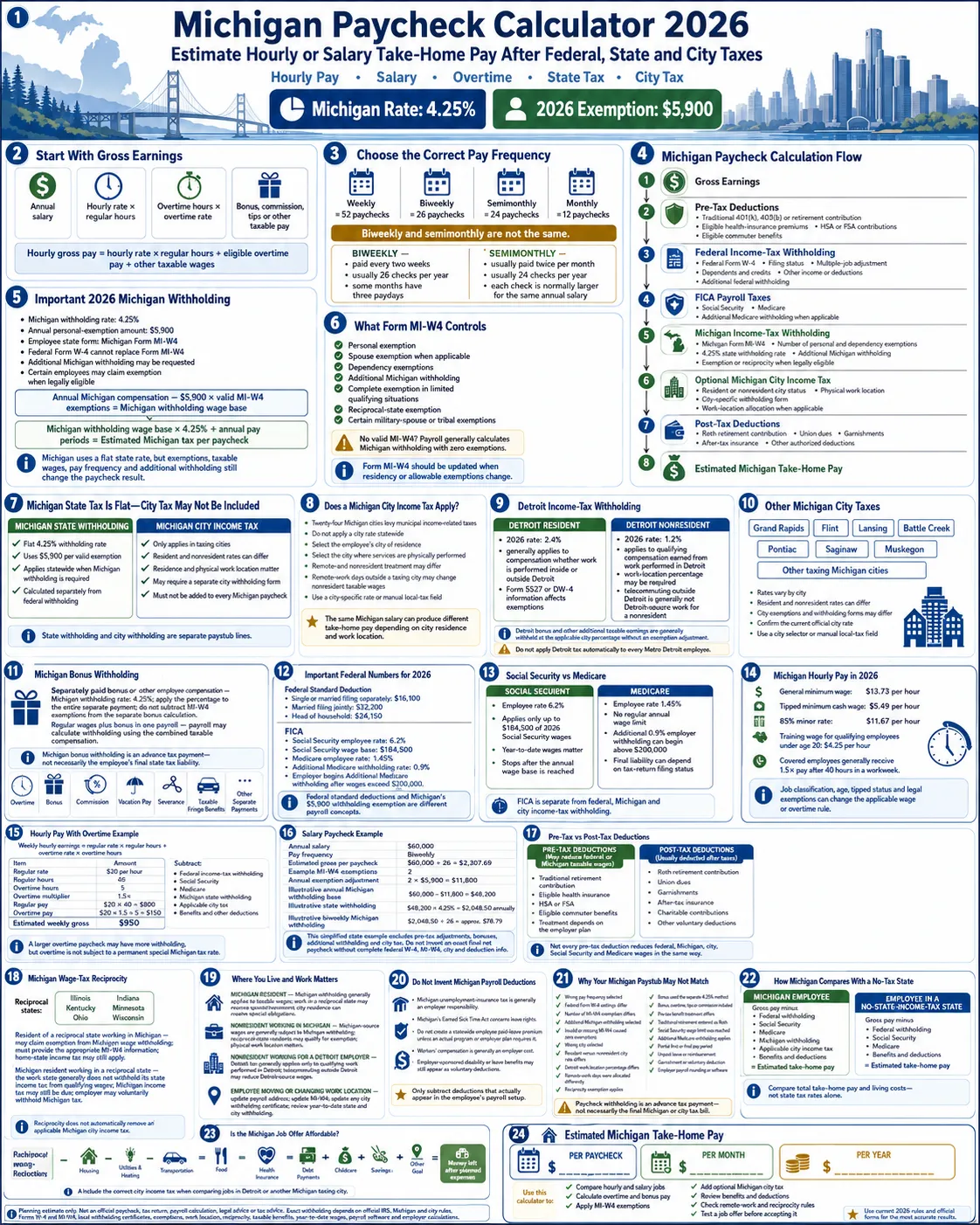
A Michigan paycheck begins with salary, hourly wages, overtime, bonus, commission or tips. Payroll may then subtract federal income-tax withholding, Social Security, Medicare, Michigan income-tax withholding, applicable city income tax, benefits and other authorized deductions.
Michigan’s 2026 withholding rate is 4.25%, and each valid MI-W4 personal or dependency exemption is worth $5,900 annually. City income tax is separate and must not be added to every Michigan employee.
Michigan Paycheck Calculator With State and City Tax
Enter the information that matches your payroll. Results update automatically. Detroit tax and other-city tax remain optional because city income tax does not apply statewide.
Michigan Form MI-W4 and the 2026 State Withholding Formula
Regular Michigan payroll
Michigan’s simplified annual calculation starts with Michigan taxable compensation, subtracts $5,900 for each valid MI-W4 personal or dependency exemption, and applies the 4.25% withholding rate.
Federal Form W-4 cannot replace Form MI-W4. The federal form controls federal withholding, while MI-W4 controls state exemptions, additional withholding and qualifying state exemptions.
Missing or invalid MI-W4
When an employee does not provide a valid Michigan certificate and no earlier valid form remains in effect, payroll generally withholds using zero exemptions.
An employee should update the form after a residency, dependency or exemption change. The employee should not claim more exemptions than are available on the Michigan income-tax return.
Michigan City Income Tax: Detroit and Other Taxing Cities
Michigan has 24 cities that levy municipal taxes related to income. City tax is not statewide, and the correct result can depend on the employee’s city of residence, physical work location, resident or nonresident status, city exemptions and local withholding certificate.
Detroit resident withholding
The 2026 Detroit resident rate is 2.4%. Detroit residents are generally subject to city withholding on compensation whether services are performed inside or outside Detroit.
Resident rate: 2.4% $600 per exemptionDetroit nonresident withholding
The 2026 Detroit nonresident rate is 1.2% on qualifying compensation earned from work performed in Detroit. Work-location allocation can be necessary when only part of the employee’s services are performed in the city.
Nonresident rate: 1.2% Allocation may apply| Taxing-city examples | What to verify | Calculator approach |
|---|---|---|
| Detroit | Resident status, Detroit work percentage, Form 5527 exemptions and any other-city credit interaction. | Built-in 2.4% resident and 1.2% nonresident modes. |
| Grand Rapids, Flint, Lansing and Battle Creek | Current city resident/nonresident rate, exemption amount and local withholding form. | Use the verified manual city-rate fields. |
| Albion, Benton Harbor, Big Rapids, East Lansing, Grayling and Hamtramck | Whether residence, work location or both create local withholding. | Do not add a city deduction without a verified local rule. |
| Other Michigan taxing cities | Official city instructions, effective date, wage allocation and exemption treatment. | Enter a manual rate only after verification. |
Michigan Paycheck Impact: State Tax and Detroit Tax
This comparison uses the current calculator inputs to show why two employees with the same gross wages can receive different take-home pay. It is a withholding comparison, not a final tax-return calculation.
| Scenario | Estimated paycheck | Estimated monthly take-home | What changes |
|---|---|---|---|
| Michigan state tax only | $0 | $0 | Federal tax, FICA, Michigan withholding and entered deductions; no city tax. |
| Michigan + Detroit resident tax | $0 | $0 | Adds an illustrative Detroit resident withholding calculation using current wages and city exemptions. |
| Illustrative difference | $0 | $0 | Shows why residence and work-city settings should be verified before comparing jobs. |
Monthly Michigan Budget From Your Paycheck
Use net pay rather than gross salary when planning housing, heating, utilities, transport, insurance, debt and savings.
Michigan Job Offer and Housing Affordability Calculator
Estimate whether a salary offer leaves room after taxes, benefits and recurring monthly costs. The result is a planning signal, not lending, legal or tax advice.
What Common Michigan Paycheck Searches Actually Mean
How This Michigan Paycheck Estimate Works
| Paycheck component | Calculation approach | Why a real paystub may differ |
|---|---|---|
| Federal income tax | Uses 2026 federal brackets, standard deduction, entered W-4 credits, other income, deductions and extra withholding. | Employers use Publication 15-T, exact W-4 steps, approved methods and payroll rounding. |
| Social Security | 6.2% of estimated Social Security wages up to $184,500. | Year-to-date wages and benefit treatment determine when the cap is reached. |
| Medicare | 1.45%, plus estimated 0.9% employer withholding on wages above $200,000. | Final Additional Medicare liability depends on filing status and combined wages. |
| Michigan state withholding | 4.25% after $5,900 per valid MI-W4 exemption, subject to wage allocation and exemption settings. | Payroll uses the employee’s actual MI-W4 and exact taxable compensation codes. |
| City income tax | Optional Detroit resident, Detroit nonresident or verified manual city rate. | City forms, exemptions, residence, predominant work city and remote-work days can change withholding. |
| Bonus and supplemental pay | Can be aggregated or estimated at federal 22% and Michigan 4.25% when separately paid. | The official payment method and prior supplemental wages affect withholding. |
Michigan Hourly Pay, Overtime and Bonus Withholding
Hourly wages and overtime
Michigan’s general minimum wage is $13.73 per hour beginning January 1, 2026. The tipped cash wage is $5.49, and the 85% rate for qualifying minors is $11.67. Covered nonexempt employees generally receive 1.5× pay after 40 hours in a workweek.
Example: $20 × 40 regular hours plus $20 × 1.5 × 5 overtime hours produces $950 weekly gross before taxes and deductions.
Separately paid bonus
Michigan’s 2026 guide applies 4.25% to the entire separate bonus or other separate compensation without subtracting MI-W4 exemptions.
Federal withholding may use the optional 22% method for separately identified qualifying supplemental wages. Social Security, Medicare and applicable city tax can still apply.
Biweekly, Semimonthly, Hourly and Salary Examples
| Example | Gross or withholding calculation | Practical note |
|---|---|---|
| $60,000 biweekly salary | $60,000 ÷ 26 = $2,307.69 gross per check | Federal tax, FICA, Michigan tax, city tax and deductions are then subtracted. |
| $60,000 semimonthly salary | $60,000 ÷ 24 = $2,500 gross per check | Annual salary is unchanged, but each of 24 checks is larger. |
| $60,000 with two MI-W4 exemptions | ($60,000 − $11,800) × 4.25% = $2,048.50 illustrative annual state withholding | Before pre-tax adjustments, bonus treatment, extra withholding or city tax. |
| $20/hour plus five overtime hours | $800 regular + $150 overtime = $950 weekly gross | Overtime is included before federal, FICA, Michigan and applicable city tax. |
Important 2026 Michigan and Federal Paycheck Numbers
| 2026 item | Amount or rule | How this tool uses it |
|---|---|---|
| Michigan withholding rate | 4.25% | Applied after the MI-W4 exemption adjustment unless a qualifying exemption applies. |
| MI-W4 exemption | $5,900 per valid exemption | Reduces the annual Michigan withholding base for regular pay. |
| Detroit withholding | 2.4% resident; 1.2% nonresident | Optional city modes with work allocation for nonresidents. |
| Detroit exemption | $600 annually per valid exemption | Reduces regular Detroit withholding wages; no exemption adjustment is applied to bonus pay. |
| Federal standard deduction | $16,100 single; $32,200 married joint; $24,150 head of household | Reduces estimated annual federal taxable income. |
| Social Security | 6.2% up to $184,500 | Applied to estimated Social Security wages. |
| Medicare | 1.45%; employer withholding adds 0.9% above $200,000 | Applied to Medicare wages without a standard annual wage cap. |
| Michigan minimum wage | $13.73 general; $5.49 tipped; $11.67 qualifying minor rate | Reference only; users enter their actual hourly rate. |
Michigan Wage-Tax Reciprocity
Michigan has reciprocal wage-tax agreements with Illinois, Indiana, Kentucky, Minnesota, Ohio and Wisconsin. A qualifying resident of one of these states working in Michigan may claim exemption from Michigan wage withholding through the appropriate MI-W4 entry.
Michigan Resident, Nonresident and Remote-Work Pay
Michigan state withholding
- Michigan residents generally remain subject to Michigan income tax on taxable wages.
- Nonresidents working physically in Michigan generally have Michigan-source wages.
- Qualifying residents of reciprocal states may claim a Michigan wage-withholding exemption.
- A nonresident working partly inside and outside Michigan may need a wage-allocation percentage.
Detroit and city withholding
- Detroit residents are generally taxed on compensation wherever services are performed.
- Detroit nonresidents are generally taxed on qualifying Detroit-performed work.
- Telecommuting outside Detroit can change a nonresident’s Detroit-source wage percentage.
- Other taxing cities can use different rates, exemptions and certificates.
Why Your Real Michigan Paystub May Not Match
Official Source Notes
The core 2026 figures below come from official government publications. This calculator remains a planning tool rather than an employer compliance system or tax-return engine.
Michigan Paycheck Calculator FAQs
What is the Michigan income-tax withholding rate for 2026?
Michigan’s 2026 employer withholding rate is 4.25%. The paycheck amount also depends on Michigan taxable compensation, valid MI-W4 exemptions, extra Michigan withholding and any applicable reciprocal-state exemption.
How much is one MI-W4 exemption worth in 2026?
Each valid personal or dependency exemption is worth $5,900 annually in Michigan’s 2026 wage-withholding calculation. The employee should not claim more exemptions than can be claimed on the Michigan income-tax return.
Can federal Form W-4 replace Michigan Form MI-W4?
No. Michigan requires its own Form MI-W4. Federal Form W-4 controls federal withholding, while Form MI-W4 controls Michigan exemptions, additional withholding and qualifying state exemptions.
How do I calculate a biweekly Michigan paycheck?
Choose biweekly pay frequency. The calculator divides annual wages and annual deductions across 26 paychecks. Semimonthly normally uses 24 paychecks, so it produces a different gross amount per check.
Does this Michigan calculator handle hourly wages and overtime?
Yes. Enter the hourly rate, regular weekly hours, overtime hours, overtime multiplier and paid workweeks. The calculator adds regular and overtime earnings before estimating federal, Michigan, city and payroll deductions.
Is overtime taxed at a special Michigan rate?
No permanent special Michigan overtime rate applies. Overtime increases taxable compensation and can increase withholding because the paycheck is larger. Michigan’s regular state withholding rate remains 4.25%.
How is a separately paid bonus withheld in Michigan?
Michigan’s 2026 guide directs employers to withhold 4.25% from a separately paid bonus or other separate employee compensation without an exemption adjustment. Federal supplemental-wage withholding may also use the 22% method when the official conditions are met.
Does every Michigan employee pay a city income tax?
No. City income tax applies only in Michigan cities that impose it. Residence, physical work location, resident or nonresident status, city-specific rules and work allocation can all affect the deduction.
What are the 2026 Detroit employee income-tax rates?
The 2026 Detroit withholding rate is 2.4% for residents and 1.2% for qualifying nonresidents. Detroit residents are generally taxed on compensation wherever earned, while nonresident withholding generally focuses on qualifying work performed in Detroit.
How do Detroit withholding exemptions work?
The 2026 Detroit withholding guide values each valid employee, spouse or dependency exemption at $600 annually. Regular payroll withholding subtracts the applicable exemption amount before applying the city rate, while bonuses or additional taxable earnings generally receive no exemption adjustment.
Which states have wage-tax reciprocity with Michigan?
Michigan has reciprocal wage-tax agreements with Illinois, Indiana, Kentucky, Minnesota, Ohio and Wisconsin. A qualifying resident of one of those states working in Michigan may claim exemption from Michigan wage withholding, but a Michigan city tax may still need separate review.
Why is my Michigan paycheck lower than the calculator result?
Common reasons include different W-4 or MI-W4 settings, city income tax, Detroit work allocation, bonus or overtime pay, benefit tax treatment, year-to-date Social Security wages, garnishments, unpaid leave and employer payroll rounding.
Does Michigan deduct unemployment insurance from employee paychecks?
Michigan unemployment-insurance contributions are generally an employer payroll cost rather than a standard employee paycheck deduction. This calculator does not invent an employee Michigan unemployment-tax line.
Can a remote worker owe Michigan or Detroit tax?
Yes, depending on residence and where services are physically performed. Michigan residents, nonresidents working in Michigan, Detroit residents and Detroit nonresidents can have different state and city results. Reciprocal-state rules may also apply.
Is this Michigan paycheck calculator official tax or payroll advice?
No. It is a planning estimate. Exact withholding depends on official IRS, Michigan and city rules, Forms W-4 and MI-W4, city certificates, work location, benefit codes, year-to-date wages, payroll software and employer calculations.
Related Paycheck Calculators
The live post sitemap could not be reliably verified during this build, so guessed or unverified article URLs were not inserted. These related topics can be linked after confirming their exact live URLs in the same-site post sitemap.
Estimate Your Michigan Take-Home Pay Before Payday
Recalculate when wages, overtime, bonus pay, Form W-4, MI-W4 exemptions, city residence, physical work location, retirement, benefits or monthly costs change.
Run the Michigan Calculator Again