
Free Connecticut Paycheck Calculator 2026
Estimate your Connecticut take-home pay from annual salary or hourly wages after federal tax, Social Security, Medicare, Connecticut withholding, CT Paid Leave, retirement, benefits, overtime, and other deductions.
Quick Answer: How Connecticut Take-Home Pay Works
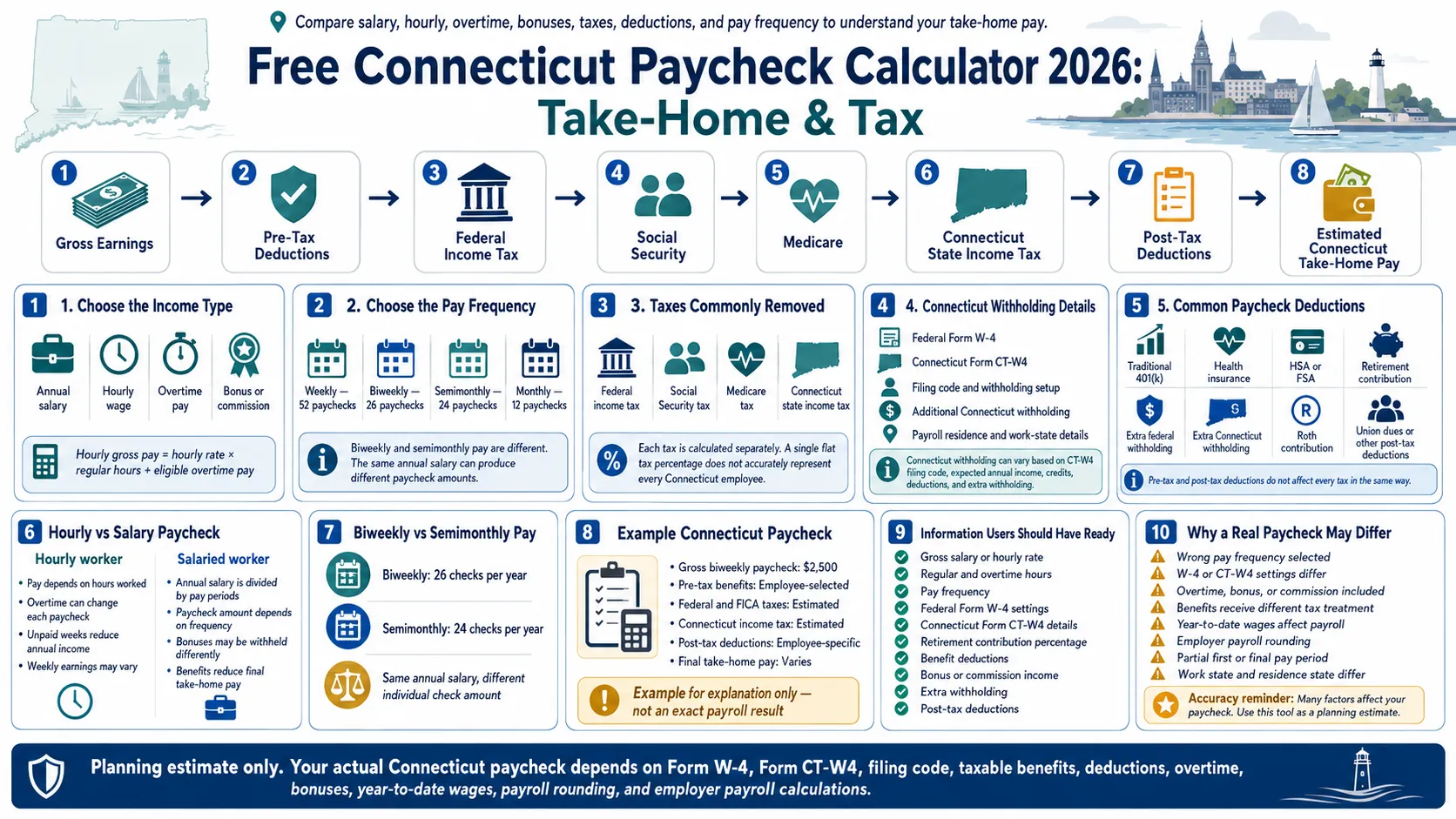
A Connecticut paycheck begins with gross wages. Payroll may then subtract federal income tax, Social Security, Medicare, Connecticut income-tax withholding, CT Paid Leave contributions, retirement, benefits, extra withholding, and post-tax deductions.
Federal Form W-4 and Connecticut Form CT-W4 are separate. The federal form controls federal withholding, while CT-W4 selects a Connecticut withholding code and allows additional or reduced state withholding per pay period.
Connecticut Paycheck Calculator With Taxes and Deductions
Enter your actual pay arrangement. Results update automatically and can also be refreshed with the calculate button.
Connecticut Tax Impact: With vs Without State Withholding
This comparison isolates the estimated Connecticut withholding effect. It can help with cross-state job comparisons, nonresident allocation, remote-work planning, and payroll troubleshooting.
| Scenario | Estimated paycheck | Estimated monthly take-home | What it means |
|---|---|---|---|
| With Connecticut withholding | $0 | $0 | Uses the selected CT-W4 code and Connecticut-source wage percentage. |
| Without Connecticut withholding | $0 | $0 | Comparison only; another state or estimated tax obligation may still apply. |
| Estimated difference | $0 | $0 | Isolates the estimated Connecticut state withholding line. |
Monthly Connecticut Budget From Your Paycheck
Gross salary does not show whether a job supports housing, utilities, transportation, debt, insurance, childcare, and savings. This snapshot converts annual net pay into a monthly planning number.
Connecticut Job Offer and Housing Affordability Calculator
Test the practical value of a salary offer after federal tax, Connecticut withholding, CT Paid Leave, benefits, housing, transportation, debt, and savings.
What Common Connecticut Paycheck Searches Actually Mean
These searches describe different problems. Each one needs a practical input, explanation, or comparison rather than a keyword list.
How This Connecticut Paycheck Estimate Works
The calculator annualizes wages, applies the selected CT-W4 code using the official 2026 calculation structure, estimates federal tax and FICA, subtracts CT Paid Leave and deductions, and divides the result by pay frequency.
| Paycheck component | Calculation approach | Why your paystub may differ |
|---|---|---|
| Federal income tax | Estimated with 2026 federal brackets, standard deduction, entered credits, and optional federal-only deductions. | Employers use Publication 15-T, exact W-4 entries, pay-period methods, and rounding. |
| Social Security | 6.2% of estimated Social Security wages up to the 2026 wage base. | Year-to-date wages and benefit treatment determine when the cap is reached. |
| Medicare | 1.45% plus an additional 0.9% employee withholding estimate above $200,000. | Final joint-return liability can differ from the employer withholding threshold. |
| Connecticut withholding | Uses CT-W4 code, personal exemption, progressive rates, phase-out add-back, recapture, and personal tax-credit tables. | Official payroll applies exact period wages, supplemental rules, CT-source allocation, and Line 2 or Line 3 adjustments. |
| CT Paid Leave | 0.5% of estimated FICA-defined wages up to the entered annual cap. | Coverage, approved private plans, exclusions, and multi-employer wage-cap treatment can differ. |
| Local income tax | Shown as zero. | Other local payroll items may appear, but Connecticut cities and towns do not generally add a separate earned-income tax line. |
Federal Form W-4 vs Connecticut CT-W4
| Form or record | What it controls | When to review it |
|---|---|---|
| Federal Form W-4 | Federal income-tax withholding | New job, marriage, dependents, second job, major income change, or repeated refund/balance-due issue |
| Connecticut Form CT-W4 | State withholding code, additional withholding, and reduced withholding | New employment, filing-status change, other income, underwithholding, exemption, or residency change |
| Form CT-W4NA | Nonresident withholding or exemption and Connecticut work allocation | Services are performed partly inside and partly outside Connecticut |
| Payroll home and work location | State sourcing and payroll-jurisdiction setup | Moving, remote-work changes, or cross-border work |
| W-2 wage boxes | Year-end federal, FICA, and state wage reporting | Taxable wage boxes differ from gross compensation |
Which Deductions Reduce Which Taxes?
“Paycheck calculator with deductions” means more than subtracting one total. The deduction category determines which wage bases may change.
| Deduction | Common treatment | What to check |
|---|---|---|
| Traditional 401(k) or 403(b) | Often reduces federal and Connecticut income-taxable wages but generally not Social Security or Medicare wages. | Compare federal and state wages with FICA wages on the paystub. |
| Health insurance | Often pre-tax through an eligible employer plan. | Verify whether it reduces federal, Connecticut, FICA, and CT Paid Leave wages. |
| HSA or FSA | Often pre-tax under eligible payroll arrangements. | Confirm annual limits and FICA treatment. |
| Commuter benefit | May receive favorable payroll treatment up to applicable limits. | Enter the actual payroll deduction, not the full commuting cost. |
| Roth retirement | Usually post-tax for income-tax purposes. | Do not enter it as traditional pre-tax retirement. |
| CT Paid Leave | Employee-funded payroll contribution for covered workers. | Coverage, private-plan treatment, and the wage cap used by each employer. |
| Union dues or garnishment | Often deducted after taxes. | Enter the actual per-paycheck amount as post-tax. |
| Extra withholding | Reduces current take-home pay but is not a benefit expense. | Keep federal and Connecticut adjustments separate. |
2026 Paycheck Numbers Used in This Calculator
| 2026 item | Amount or rule | How it is used |
|---|---|---|
| Federal standard deduction | $16,100 single, $32,200 married filing jointly, and $24,150 head of household | Reduces estimated federal taxable income. |
| Federal marginal rates | 10%, 12%, 22%, 24%, 32%, 35%, and 37% | Applied progressively to estimated federal taxable income. |
| Social Security wage base | $184,500 | Caps the 6.2% Social Security estimate and the default CT Paid Leave wage cap. |
| Medicare | 1.45%, plus 0.9% employer withholding above $200,000 | Applied to estimated Medicare wages. |
| Connecticut withholding rates | 2%, 4.5%, 5.5%, 6%, 6.5%, 6.9%, and 6.99%, with CT-W4 tables and adjustments | Applied through the official code-specific calculation structure. |
| CT Paid Leave contribution | 0.5% for covered employees | Subtracted from estimated take-home pay up to the wage cap. |
| Connecticut local income tax | No separate city or town earned-income tax in this estimate | Local income-tax output remains zero. |
Biweekly vs semimonthly pay in Connecticut
Biweekly pay normally means 26 checks per year. Semimonthly normally means 24. The annual salary can remain the same while each check amount changes.
Biweekly: 26 checksSemimonthly: 24 checksHourly vs salary paycheck
Hourly workers should enter rate, regular hours, overtime, and paid workweeks. Salaried workers should enter annual base salary and expected bonus or commission separately.
Hourly: rate × hoursSalary: annual compensationConnecticut Salary After Tax Examples
These dynamic examples use a single federal filer, CT-W4 Code F, biweekly pay, CT Paid Leave, and no retirement or benefit deductions. Use the main calculator for your own setup.
| Common salary search | Estimated biweekly take-home | Estimated monthly take-home | What to check next |
|---|---|---|---|
| $50,000 salary after taxes in Connecticut | $0 | $0 | Housing, insurance, CT Paid Leave, and commuting. |
| $75,000 salary after taxes in Connecticut | $0 | $0 | Retirement percentage, CT-W4 code, and savings. |
| $100,000 salary after taxes in Connecticut | $0 | $0 | W-4 credits, benefit tax treatment, and extra withholding. |
| $150,000 salary after taxes in Connecticut | $0 | $0 | Recapture, bonuses, Social Security wage base, and Medicare. |
Connecticut Resident, Nonresident, Remote Work, and Moving Notes
Why Your Real Connecticut Paycheck May Not Match
- The selected pay frequency does not match the payroll calendar.
- Your CT-W4 withholding code differs from the calculator selection.
- CT-W4 Line 2 additional withholding or Line 3 reduced withholding was not entered.
- Connecticut-source wages are apportioned because work occurs in more than one state.
- Traditional retirement was entered as Roth, or Roth was treated as pre-tax.
- A health, HSA, FSA, or commuter benefit reduces different wage boxes than expected.
- CT Paid Leave coverage, private-plan treatment, or wage-cap tracking differs.
- The check contains overtime, bonus, tips, commission, retro pay, severance, or reimbursement.
- Payroll uses official period tables, actual pay dates, year-to-date wages, and rounding.
- Social Security withholding changes after cumulative wages reach the annual wage base.
- The first or final paycheck covers only part of a pay period.
How to Match This Estimate With Your Paystub
Official Source Notes
This independent calculator summarizes official information for planning. Employers should use current official withholding publications and payroll systems for compliance.
Connecticut Paycheck Calculator FAQs
How much is my paycheck after taxes in Connecticut?
Enter salary or hourly wages, pay frequency, federal filing status, CT-W4 code, Connecticut-source wage percentage, retirement, benefits, paid leave, and deductions. The calculator estimates take-home pay per paycheck, per month, and per year.
What Connecticut form controls state withholding?
Form CT-W4 controls the employee withholding code, additional withholding, and reduced withholding. Federal Form W-4 separately controls federal income-tax withholding.
What do CT-W4 codes A, B, C, D, E, and F mean?
The codes represent different filing and income situations. Code F commonly applies to single filers, B to head of household, C to certain married or qualifying surviving spouse situations, A to specified married situations, D to employees requesting higher withholding because of other income, and E to qualifying exemption situations.
Can I calculate hourly pay and overtime in Connecticut?
Yes. Select hourly pay and enter the rate, regular hours, overtime hours, multiplier, and paid workweeks. The calculator adds those wages before estimating federal tax, Connecticut withholding, FICA, and paid leave.
What is the difference between biweekly and semimonthly pay?
Biweekly pay normally means 26 paychecks per year. Semimonthly pay normally means 24. The annual salary can remain the same while the amount of each check changes.
Does a traditional 401(k) reduce Connecticut paycheck taxes?
Traditional retirement contributions often reduce federal and Connecticut income-taxable wages, but generally do not reduce Social Security and Medicare wages. Actual treatment depends on the plan.
How much is the Connecticut Paid Leave deduction in 2026?
The CT Paid Leave Authority maintained the employee contribution rate at 0.5% for 2026. Contributions generally apply to FICA-defined wages up to the Social Security contribution and benefit base.
Why does ADP or my payroll portal show a different amount?
Employer payroll systems can use exact W-4 and CT-W4 settings, year-to-date wages, benefit tax coding, pay dates, official tables, supplemental-pay rules, and rounding. A public calculator uses planning assumptions.
Does this calculator include bonuses and commissions?
Yes. Enter expected annual bonus, commission, tips, or other wages for a planning estimate. The actual supplemental paycheck may use a different withholding method.
What if I work in Connecticut but live in another state?
A nonresident can have Connecticut withholding on wages for services performed in Connecticut. If work is split between states, Connecticut-source wages may need to be apportioned and the resident state may also require tax reporting.
What if I work remotely outside Connecticut for a Connecticut employer?
Connecticut says a nonresident whose services are performed entirely outside Connecticut generally is not subject to Connecticut wage withholding merely because the employer or payroll office is located in Connecticut. Verify your facts and current guidance.
Does Connecticut have local city income tax withholding?
Connecticut paycheck planning generally does not include a separate city or town earned-income tax. The main income-tax withholding line is Connecticut state withholding.
Why are Social Security wages different from federal taxable wages?
Some pre-tax deductions reduce federal income-taxable wages but not Social Security or Medicare wages. That is why taxable wage boxes on a paystub or W-2 may not match.
Can I use this calculator before accepting a Connecticut job offer?
Yes. Use the job-offer tool to compare estimated monthly take-home pay with housing, utilities, transportation, food, debt, benefits, paid leave, savings, and other recurring costs.
Can this calculator replace official Connecticut payroll tables or tax advice?
No. It is a planning estimate. Employers should use the official 2026 Connecticut withholding tables and calculation rules, and individuals should verify important tax or payroll decisions with official sources or a qualified professional.
Related Paycheck Calculators
No same-site article URL was added because the live post sitemap could not be verified reliably during preparation.
Estimate Your Connecticut Take-Home Pay Before Payday
Recalculate whenever salary, hourly schedule, overtime, work location, W-4, CT-W4 code, CT Paid Leave coverage, benefits, retirement, housing, or monthly costs change. Use the result before accepting a job, signing a lease, or changing deductions.
Run the Connecticut Calculator Again