
Free Kansas Paycheck Calculator 2026
Estimate your Kansas take-home pay from annual salary or hourly wages. This tool helps you review federal tax, Social Security, Medicare, Kansas income tax, pre-tax deductions, post-tax deductions, overtime, and monthly affordability in one place.
Quick Answer: How Kansas Take-Home Pay Works
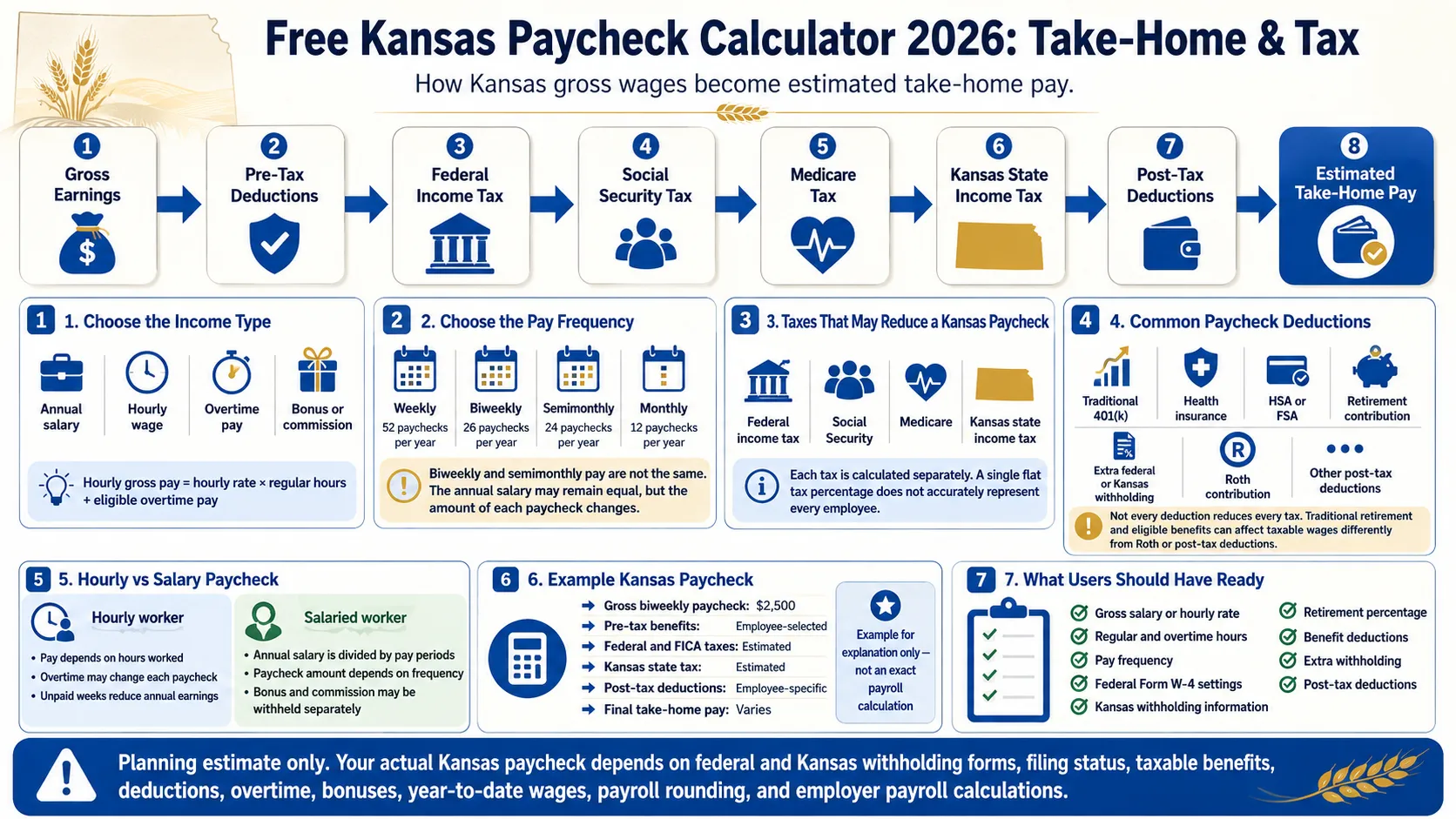
A Kansas paycheck usually starts with gross pay and then subtracts federal income tax, Social Security, Medicare, Kansas income tax, retirement contributions, benefit deductions, extra withholding, and post-tax deductions.
That means two workers with the same annual salary can still receive different paychecks if they have different W-4 settings, Kansas withholding choices, overtime, benefits, or pay frequencies.
Kansas Paycheck Calculator
Enter your pay setup, deductions, and monthly goals. Results update automatically and can also be refreshed with the calculate button.
Kansas Tax Impact: With vs Without Kansas Income Tax
This comparison isolates the estimated effect of Kansas income tax on your take-home pay. It is useful when comparing Kansas with another state, checking a move, or reviewing net-pay differences.
| Scenario | Estimated paycheck | Estimated monthly take-home | What it means |
|---|---|---|---|
| With Kansas income-tax estimate | $0 | $0 | Use this for normal Kansas paycheck planning. |
| Without Kansas income-tax estimate | $0 | $0 | Use this only as a comparison view, not as a final Kansas payroll result. |
| Estimated difference | $0 | $0 | This shows the practical effect of the Kansas state-tax line. |
Monthly Kansas Budget From Your Paycheck
A paycheck estimate is more useful when it shows what happens after housing, bills, and savings. This section converts annual net pay into a monthly budgeting number.
Kansas Job Offer & Rent Affordability Calculator
Use this second tool to test the real value of a salary offer after taxes, housing, and regular monthly expenses.
How This Kansas Paycheck Estimate Works
The calculator annualizes salary or hourly earnings, adds overtime and other wages, subtracts selected deductions, then estimates the main taxes and divides the result by the chosen pay schedule.
| Paycheck component | Calculation approach | Why your paystub may differ |
|---|---|---|
| Federal income tax | Estimated with 2026 federal brackets and standard deductions. | Employers use official withholding tables, W-4 data, pay-period methods, and rounding. |
| Social Security | 6.2% of Social Security wages up to the 2026 wage base. | Year-to-date wages and taxable-benefit treatment affect the result. |
| Medicare | 1.45% of Medicare wages, plus an added 0.9% estimate above $200,000. | Additional Medicare withholding rules apply per employee and can differ on a joint return. |
| Kansas income tax | Planning estimate using a Kansas state-tax model and filing status assumptions. | Kansas withholding forms, allowances, payroll tables, and tax-year changes can affect withholding. |
| Pre-tax deductions | Subtracted before estimating taxes for planning purposes. | Not every benefit reduces every tax, and employer plans can vary. |
| Post-tax deductions | Taken after the tax estimate and reduce take-home pay only. | Roth contributions, dues, or other after-tax items may be coded differently. |
Before You Calculate: Information You Should Have Ready
| Information | Where to find it | Why it matters |
|---|---|---|
| Gross salary or hourly rate | Offer letter, paystub, or payroll portal | It is the starting point for gross-to-net pay calculations. |
| Regular and overtime hours | Timesheet, schedule, or prior paystub | Hourly workers need this to estimate changing weekly wages correctly. |
| Pay frequency | Payroll calendar or paystub | Weekly, biweekly, semimonthly, and monthly schedules produce different paycheck amounts. |
| Federal Form W-4 | HR or payroll portal | Federal withholding changes based on filing status, credits, and extra withholding. |
| Kansas withholding settings | Payroll setup or Kansas K-4 records | State withholding can vary from one employee to another. |
| Pre-tax and post-tax deductions | Benefits portal or itemized paystub deductions | Benefit type determines how much of your paycheck is taxable. |
Which Forms and Records Control Your Kansas Paycheck?
| Form or record | What it controls | Practical note |
|---|---|---|
| Federal Form W-4 | Federal income-tax withholding | Review it after a new job, marriage, dependents, a second job, or repeated refund/balance-due problems. |
| Kansas Form K-4 | Kansas income-tax withholding setup | This is the main state withholding form many Kansas workers should check. |
| Payroll profile | Address, pay schedule, and deduction coding | A wrong home address or state setup can create withholding surprises. |
| Benefits enrollment record | Insurance, HSA/FSA, commuter, and retirement deductions | These deductions often cause the biggest difference between gross and net pay. |
| W-2 wage boxes | Year-end tax reporting of wages and withholding | Useful when federal taxable wages do not match Social Security or Medicare wages. |
Which Deductions Reduce Which Taxes?
“Paycheck calculator with deductions” means more than subtracting one total. Different deductions can reduce different taxable wage bases.
| Deduction | Common treatment | What to check |
|---|---|---|
| Traditional 401(k) | Often reduces federal and state income-taxable wages but not Social Security or Medicare wages. | Compare federal taxable wages with Social Security wages on the paystub. |
| Health insurance | Often pre-tax through an eligible employer plan. | Verify whether it reduces federal, state, and FICA wages. |
| HSA or FSA | Often pre-tax when contributed through payroll under eligible plan rules. | Check annual limits and whether the employer plan changes FICA wages. |
| Commuter benefits | May receive favorable payroll-tax treatment up to allowed limits. | Use the actual payroll deduction amount rather than the full commuting cost. |
| Roth 401(k) | Usually post-tax for income-tax purposes. | Do not enter Roth contributions as traditional pre-tax retirement. |
| Union dues or garnishment | Often deducted after taxes. | Enter the actual per-paycheck amount as post-tax. |
| Extra withholding | Reduces current take-home pay but is not a benefit expense. | Keep it separate from regular deductions for a cleaner estimate. |
| Other post-tax items | Reduce take-home pay only. | Use your paystub labels so you do not double-count a deduction. |
2026 Paycheck Numbers Used in This Calculator
| 2026 item | Amount or rule | How it is used here |
|---|---|---|
| Federal standard deduction | $16,100 single, $32,200 married filing jointly, and $24,150 head of household | Reduces estimated federal taxable income. |
| Federal marginal tax rates | 10%, 12%, 22%, 24%, 32%, 35%, and 37% | Applied progressively in the planning estimate. |
| Social Security wage base | $184,500 | Caps wages subject to the 6.2% Social Security estimate. |
| Social Security employee rate | 6.2% | Applied to estimated Social Security wages up to the cap. |
| Medicare employee rate | 1.45%, plus a 0.9% additional estimate above $200,000 | Applied to estimated Medicare wages. |
| Kansas withholding and tax rules | Kansas payroll withholding depends on official state forms, instructions, and current state tax structure | Modeled as a planning estimate rather than an exact payroll-table result. |
Biweekly vs semimonthly pay in Kansas
Biweekly pay normally means 26 checks per year. Semimonthly pay normally means 24 checks per year. The annual salary may be identical, but each paycheck amount will not be the same.
Biweekly: 26 checks Semimonthly: 24 checksHourly vs salary paycheck
Hourly workers should enter rate, regular hours, overtime hours, and workweeks. Salaried workers should enter annual salary and any additional bonus or commission income.
Hourly: rate × hours Salary: annual compensationSalary After Tax Examples People Commonly Search
These are simplified dynamic examples for a single Kansas filer paid biweekly with no retirement or benefit deductions. Use the main calculator for a more personal result.
| Common salary search | Estimated biweekly take-home | Estimated monthly take-home | What to check next |
|---|---|---|---|
| $50,000 salary after taxes in Kansas | $0 | $0 | Housing ratio, insurance deductions, and commuting costs. |
| $75,000 salary after taxes in Kansas | $0 | $0 | Retirement percentage, bills, and savings goals. |
| $100,000 salary after taxes in Kansas | $0 | $0 | W-4, K-4, benefits, and extra withholding settings. |
| $150,000 salary after taxes in Kansas | $0 | $0 | Social Security wage base, Medicare, and bonus treatment. |
Kansas Resident, Cross-State, and Work Arrangement Notes
Why Your Real Kansas Paycheck May Not Match the Calculator
- The selected pay frequency does not match your real payroll schedule.
- Your federal W-4 filing status, credits, or extra withholding are different.
- Your Kansas withholding settings or K-4 setup differ from the estimate.
- Traditional retirement was entered like a Roth contribution, or vice versa.
- A health, HSA, FSA, or other benefit reduces different taxable wages than expected.
- The paycheck includes overtime, bonus, commission, retro pay, tips, or reimbursement.
- Payroll software uses official withholding tables and year-to-date wages for the actual pay date.
- Social Security withholding changes after cumulative wages reach the annual wage base.
- The first or final paycheck covers only part of a pay period.
How to Match the Calculator Result With Your Real Paystub
Official Source Notes
This is an independent planning calculator. Employers should rely on official payroll instructions, and individuals should verify important tax or withholding decisions with official agencies or a qualified professional.
Kansas Paycheck Calculator FAQs
How much is my paycheck after taxes in Kansas?
Enter your salary or hourly wage, pay frequency, filing status, Kansas tax setting, retirement contributions, benefits, and deductions. The calculator estimates take-home pay per paycheck, per month, and per year.
Is Kansas income tax separate from federal tax?
Yes. Federal income tax and Kansas income tax are separate paycheck items. Social Security and Medicare are separate from both of those.
Can I calculate hourly pay in Kansas?
Yes. Select hourly pay and enter your hourly rate, regular weekly hours, overtime hours, overtime multiplier, and paid workweeks per year.
How do I calculate a biweekly paycheck in Kansas?
Select biweekly pay frequency. The calculator divides annual pay, taxes, and deductions by 26 paychecks.
Does overtime increase my take-home pay?
Usually yes. Overtime increases gross wages, but your withholding and deductions can also rise, so net pay does not increase by the full overtime amount.
Do 401(k) contributions reduce taxes?
Traditional 401(k) contributions often reduce federal and state income-taxable wages, but they generally do not reduce Social Security and Medicare wages.
Are health insurance deductions pre-tax?
Many employer health-plan deductions are pre-tax, but not all. Check your paystub and benefits summary to see how your plan affects taxable wages.
Why does my paycheck not match the calculator?
Differences often come from W-4 or K-4 settings, benefit treatment, special pay items, year-to-date wages, payroll rounding, or the exact official withholding tables used by your employer.
What is the difference between biweekly and semimonthly pay?
Biweekly pay normally means 26 checks per year. Semimonthly pay normally means 24 checks per year. The annual salary can be the same, but each paycheck amount will differ.
Can I use this calculator for a Kansas job offer?
Yes. The job-offer tool helps compare estimated monthly take-home pay with rent, bills, transportation, debt, food, savings, and other recurring expenses.
Does this calculator include bonuses or commission?
Yes. Enter expected annual bonus, commission, or other extra wages in the additional-income field for a planning estimate.
What form affects Kansas withholding?
Federal withholding is mainly controlled by Form W-4. Kansas withholding is commonly affected by the Kansas K-4 and your payroll profile.
What if I moved into or out of Kansas?
Update your payroll address and state withholding setup as soon as possible. A move can change which state tax estimate is most relevant.
Is this calculator tax or legal advice?
No. This tool is a planning estimate only and should not replace official payroll guidance, tax advice, or legal advice.
Can this replace official payroll tables?
No. Employers should use official IRS and Kansas withholding instructions and payroll software. This calculator is designed for planning and budgeting.
Related Paycheck Calculators
Calculate Again Before a Job Change or Budget Decision
Recalculate whenever your salary, hourly schedule, overtime, W-4, Kansas withholding settings, benefits, rent, or savings goals change. Use the result before accepting a job offer, signing a lease, or updating payroll deductions.
Run the Kansas Calculator Again