
Wisconsin Paycheck Calculator 2026
Estimate Wisconsin take-home pay from annual salary or hourly wages after federal income tax, Social Security, Medicare, Wisconsin withholding, retirement, benefits, overtime, extra withholding and post-tax deductions.
Quick Answer: How Wisconsin Take-Home Pay Works
A Wisconsin paycheck normally starts with gross wages and then subtracts federal income-tax withholding, Social Security, Medicare, Wisconsin withholding when it applies, retirement contributions, benefit premiums, extra withholding and post-tax deductions.
Wisconsin Form WT-4 controls state withholding status, claimed exemptions and any additional amount. Wisconsin also has wage reciprocity with Illinois, Indiana, Kentucky and Michigan, so residence and work location can materially change the state line on a paycheck.
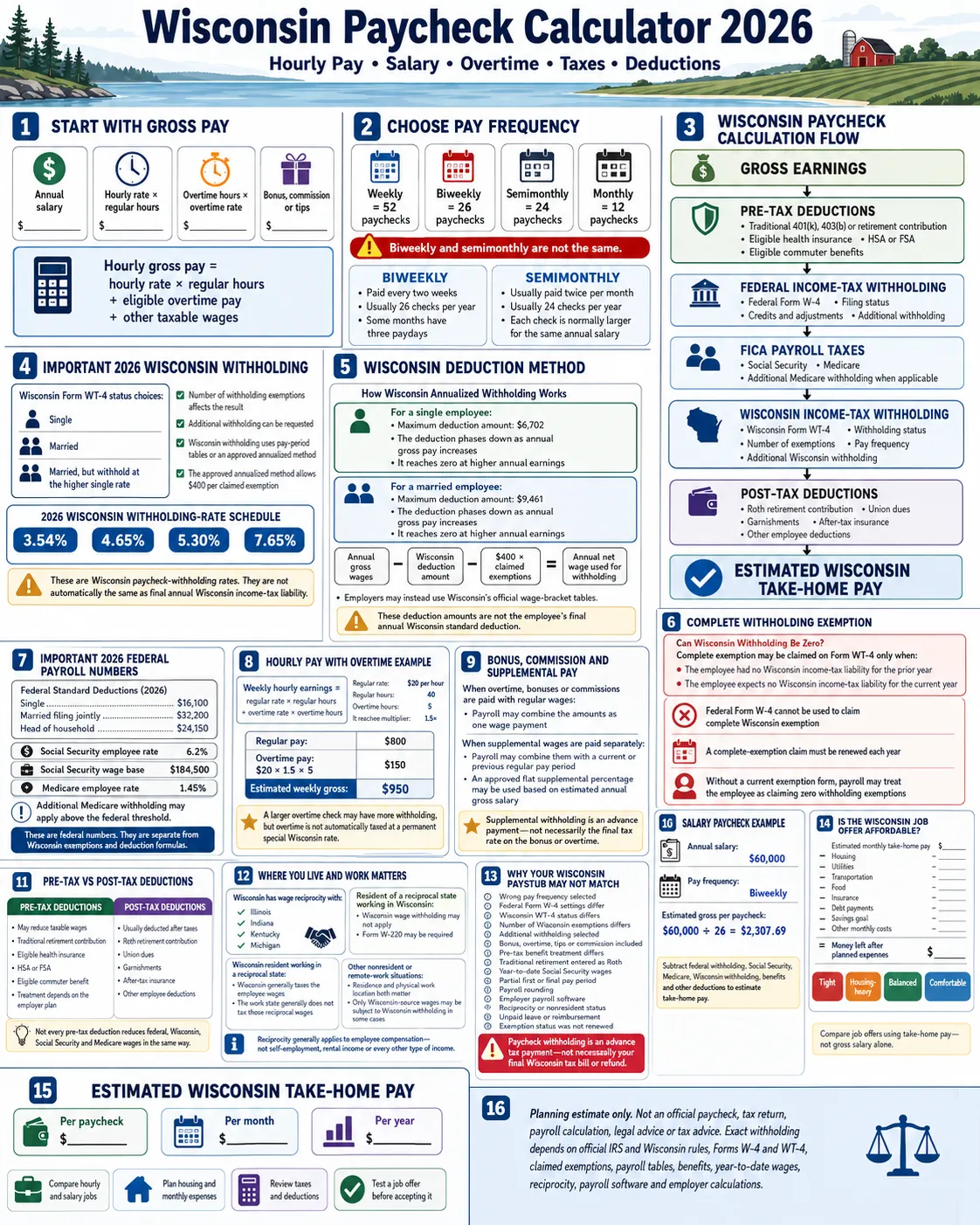
Wisconsin Paycheck Calculator With Taxes and Deductions
Enter the details that match your actual pay arrangement. Results update automatically and can also be refreshed with the calculate button.
Wisconsin Tax Impact: With vs Without State Withholding
This comparison isolates the estimated Wisconsin withholding effect. It is useful for reciprocity planning, remote-work reviews and checking whether payroll is using the intended WT-4 setup.
| Scenario | Estimated paycheck | Estimated monthly take-home | Practical meaning |
|---|---|---|---|
| With Wisconsin withholding estimate | $0 | $0 | Uses WT-4 status, exemptions and the approved 2026 annualized schedule. |
| Without Wisconsin withholding estimate | $0 | $0 | Useful for supported reciprocity or comparison; another state may still apply. |
| Estimated Wisconsin difference | $0 | $0 | This is estimated withholding impact, not final annual tax liability. |
Monthly Wisconsin Budget From Your Paycheck
Gross salary alone does not show whether a job can support housing, winter utilities, transportation, debt, insurance and savings. This snapshot turns estimated annual net pay into a monthly planning number.
Wisconsin Job Offer and Housing Affordability Calculator
Test the practical value of a salary offer after estimated taxes, benefits, housing, transport, debt, savings and normal monthly costs.
Common Wisconsin Paycheck Searches Explained
These searches describe different payroll problems. Each requires different inputs rather than a repeated keyword mention.
How This Wisconsin Paycheck Estimate Works
The calculator annualizes regular wages, overtime and other earnings. It then estimates federal taxable wages, FICA wages, federal income tax, Social Security, Medicare, Wisconsin withholding, deductions and extra withholding before dividing the result by the selected pay schedule.
| Paycheck component | Calculation approach | Why a paystub may differ |
|---|---|---|
| Federal income tax | Estimated with 2026 federal brackets, standard deductions, entered credits and optional federal-only deductions. | Employers use Publication 15-T, Form W-4 details, pay-period methods and rounding. |
| Social Security | 6.2% of estimated Social Security wages up to the 2026 wage base. | Year-to-date wages and benefit tax treatment determine when the wage base is reached. |
| Medicare | 1.45% of Medicare wages plus 0.9% employee withholding estimate above $200,000. | The employer withholding threshold can differ from final joint-return liability. |
| Wisconsin withholding | Uses the January 2026 approved annualized method, WT-4 status and $400 per exemption. | An employer may use official wage-bracket tables, different taxable wages or exact payroll rounding. |
| Benefits and deductions | Separates traditional retirement, pre-tax benefits, post-tax items and extra withholding. | A deduction may reduce federal, Wisconsin, FICA, all or none of those wage bases. |
Wisconsin Form WT-4: Status, Exemptions and Complete Exemption
| WT-4 item | What it changes | Practical action |
|---|---|---|
| Single | Uses the single deduction formula in the approved annualized method. | Select when it matches the WT-4 status stored by payroll. |
| Married | Uses the married deduction formula before exemptions and the rate schedule. | Do not assume federal filing status automatically updates WT-4. |
| Married, higher single rate | Uses higher single-rate treatment for withholding planning. | Useful when elected on WT-4; it can reduce underwithholding risk. |
| Claimed exemptions | The approved annualized method subtracts $400 for each claimed exemption. | Use the count actually filed with the employer. |
| Additional withholding | Adds a fixed Wisconsin amount to each paycheck. | Enter the exact per-check amount requested. |
| Complete exemption | Can stop Wisconsin withholding when prior-year and current-year no-liability tests are met. | Renew annually; federal W-4 cannot claim complete Wisconsin exemption. |
2026 Wisconsin Withholding Formula Used by This Calculator
| Step | 2026 approved annualized method | Calculator treatment |
|---|---|---|
| 1. Annualize wages | Payroll-period wages × number of periods per year. | Uses annual salary or annualized hourly, overtime and other wages. |
| 2. Single deduction | $6,702 below $17,780; phases down by 12% of income over $17,780; zero at $73,630 or more. | Applied to Single and Married higher-single status. |
| 3. Married deduction | $9,461 below $25,727; phases down by 20% of income over $25,727; zero at $73,032 or more. | Applied when Married WT-4 status is selected. |
| 4. Exemptions | Subtract $400 × claimed exemptions. | Uses the entered WT-4 exemption count. |
| 5. Rate schedule | 3.54%, 4.65%, 5.30% and 7.65% progressive withholding schedule. | Applies official bases and thresholds to annual net wage. |
Wisconsin Hourly Pay With Overtime, Bonus and Commission
Hourly pay and overtime
Enter regular weekly hours, overtime hours, the correct multiplier and paid workweeks. The calculator adds overtime to annual gross wages before estimating federal and Wisconsin withholding.
Overtime is not automatically taxed at a permanent special rate. A larger check can create higher withholding because payroll annualizes or combines that payment.
Bonus, commission and supplemental wages
When supplemental wages are paid with regular wages, Wisconsin allows payroll to treat the combined amount as one wage payment. When paid separately, other approved methods may apply.
The 3.54%, 4.65%, 5.30% and 7.65% flat percentages in the guide are approved for certain supplemental-wage calculations, not regular salary withholding.
2026 Federal and Wisconsin Numbers Used
| 2026 item | Amount or rule | How it is used |
|---|---|---|
| Federal standard deduction | $16,100 single, $32,200 married filing jointly, $24,150 head of household | Reduces estimated federal taxable income. |
| Federal marginal rates | 10%, 12%, 22%, 24%, 32%, 35% and 37% | Applied progressively to estimated annual federal taxable income. |
| Social Security | 6.2% employee rate; $184,500 wage base | Caps employee OASDI at the annual wage base. |
| Medicare | 1.45%, plus 0.9% employer withholding above $200,000 | Applied to estimated Medicare wages. |
| WT-4 exemption amount | $400 per claimed exemption under the approved annualized method | Reduces annual net wage before the Wisconsin rate schedule. |
| Wisconsin withholding schedule | 3.54%, 4.65%, 5.30% and 7.65% | Applied progressively after the status deduction and exemptions. |
Biweekly vs Semimonthly Pay in Wisconsin
Biweekly pay normally means 26 checks per year. Semimonthly pay normally means 24. The annual salary can be identical, but a semimonthly check is usually larger because salary is divided by fewer checks.
Hourly vs Salary Paycheck
Hourly workers should calculate regular wages and overtime separately. Salaried workers should enter annual base salary and add expected bonus or commission. Both should enter the real pay frequency and deductions.
Wisconsin Salary After Tax Examples People Search
These dynamic examples assume a single employee, biweekly pay, one WT-4 exemption and no benefit or retirement deductions. Use the main calculator for a personal estimate.
| Common salary search | Estimated biweekly take-home | Estimated monthly take-home | What to check next |
|---|---|---|---|
| $40,000 salary after taxes in Wisconsin | $0 | $0 | Housing, insurance, transport and benefit premiums. |
| $50,000 salary after taxes in Wisconsin | $0 | $0 | Debt, winter utilities and retirement contribution. |
| $75,000 salary after taxes in Wisconsin | $0 | $0 | WT-4 exemptions, health benefits and savings target. |
| $100,000 salary after taxes in Wisconsin | $0 | $0 | W-4 credits, extra withholding and job-offer costs. |
| $150,000 salary after taxes in Wisconsin | $0 | $0 | Bonus treatment, Social Security wage base and Medicare. |
Wisconsin Reciprocity, Nonresident and Remote-Work Notes
Why ADP or an Employer Payroll Portal May Show a Different Result
| Possible difference | Public planning calculator | Employer payroll system |
|---|---|---|
| Federal W-4 | Uses entered filing status, credits, deductions and extra withholding. | Uses the exact W-4 stored in payroll. |
| Wisconsin WT-4 | Uses entered status, exemptions and additional withholding. | Uses the exact WT-4 and may use wage-bracket tables. |
| Year-to-date wages | Models a full year from current inputs. | Knows prior checks and cumulative Social Security wages. |
| Benefit setup | Uses the tax treatment selected by the user. | Knows the plan’s exact federal, Wisconsin and FICA treatment. |
| Special pay | Annualizes overtime, bonus and commission. | May use combined, supplemental, retro-pay or special methods. |
Why Your Real Wisconsin Paycheck May Not Match
- The selected weekly, biweekly, semimonthly or monthly frequency is wrong.
- Federal W-4 filing status, Step 2, credits, deductions or extra withholding differ.
- Wisconsin WT-4 status, exemption count or additional withholding differ.
- Payroll uses official wage-bracket tables instead of the annualized method.
- The employee qualifies for reciprocity but payroll does not have Form W-220.
- Traditional retirement was entered as Roth, or Roth was entered as pre-tax.
- A health, HSA, FSA or commuter benefit affects different wage boxes than expected.
- The check includes overtime, bonus, commission, tips, retro pay, severance or reimbursement.
- Year-to-date Social Security wages changed the amount subject to OASDI.
- The first or final check covers only part of a pay period.
- A complete Wisconsin exemption was not renewed for the current year.
How to Match the Estimate With Your Real Paystub
Official Source Notes
This independent calculator summarizes official information for planning. Employers should use official publications and payroll systems for compliance.
Wisconsin Paycheck Calculator FAQs
How much is my paycheck after taxes in Wisconsin?
Enter salary or hourly wages, pay frequency, filing status, WT-4 status, exemptions, retirement, benefits, overtime and deductions. The calculator estimates take-home pay per paycheck, per month and per year.
Does Wisconsin have state income tax?
Yes. Wisconsin imposes individual income tax, and employers generally withhold Wisconsin tax from covered wages unless an exemption, reciprocity rule or other exception applies.
What Wisconsin withholding rates are used for 2026?
The approved January 2026 annualized withholding schedule uses progressive rates of 3.54%, 4.65%, 5.30% and 7.65% after the applicable status deduction and WT-4 exemptions.
How do WT-4 exemptions affect my paycheck?
Under Wisconsin’s approved annualized method, payroll subtracts $400 for each claimed exemption before applying the withholding schedule. Actual payroll may use official wage-bracket tables.
Can I calculate hourly pay and overtime in Wisconsin?
Yes. Select hourly pay and enter the regular rate, regular weekly hours, overtime hours, overtime multiplier and paid workweeks. The tool adds overtime before estimating taxes and deductions.
What is the difference between biweekly and semimonthly pay?
Biweekly pay normally means 26 checks per year. Semimonthly pay normally means 24. The same annual salary therefore produces different individual check amounts.
Does a traditional 401(k) reduce Wisconsin paycheck taxes?
A traditional pre-tax retirement contribution can reduce federal and Wisconsin income-taxable wages, but it generally does not reduce Social Security or Medicare wages. Actual plan treatment controls.
Does this calculator include bonuses and commissions?
Yes. Enter expected annual bonus, commission, tips or other wages. Actual supplemental-wage withholding can differ depending on how and when the employer pays it.
Which states have wage reciprocity with Wisconsin?
Wisconsin has employee-wage reciprocity agreements with Illinois, Indiana, Kentucky and Michigan. Documentation such as Form W-220 may be required.
What if I live in Illinois, Indiana, Kentucky or Michigan and work in Wisconsin?
Qualifying employee compensation may be exempt from Wisconsin wage tax under reciprocity, while the resident state generally taxes it. Confirm eligibility and submit the required form to payroll.
Can I claim complete exemption from Wisconsin withholding?
Complete exemption may be claimed on Form WT-4 only when the prior-year and current-year no-liability tests are met. The claim must be renewed annually, and federal Form W-4 cannot claim Wisconsin exemption.
Why does ADP or my payroll portal show a different amount?
An employer system uses the exact W-4, WT-4, year-to-date wages, benefit tax treatment, official payroll method, pay date and rounding. This calculator uses annual planning estimates.
Does Wisconsin have a local city wage income tax?
Wisconsin employee paychecks do not normally include a separate city wage income-tax line. Property, sales and other local taxes can affect cost of living but are not modeled as employee wage withholding here.
Can I use this calculator before accepting a Wisconsin job offer?
Yes. Use the job-offer tool to compare estimated monthly take-home pay with housing, utilities, food, transportation, debt, savings, benefits and other recurring costs.
Can this calculator replace official payroll tables or tax advice?
No. It is a planning estimate and cannot replace IRS Publication 15-T, Wisconsin Publication W-166, employer payroll software, tax preparation, legal advice or professional payroll guidance.
Related Paycheck Calculators
Only the verified site homepage is linked below. Other relevant state calculator names are shown as suggestions until their sitemap URLs are verified.
Estimate Your Wisconsin Take-Home Pay Before Payday
Recalculate whenever salary, hourly schedule, overtime, WT-4 exemptions, reciprocity, benefits, retirement, housing or monthly costs change. Use the result before accepting a job, signing a lease or updating payroll forms.
Run the Wisconsin Calculator Again